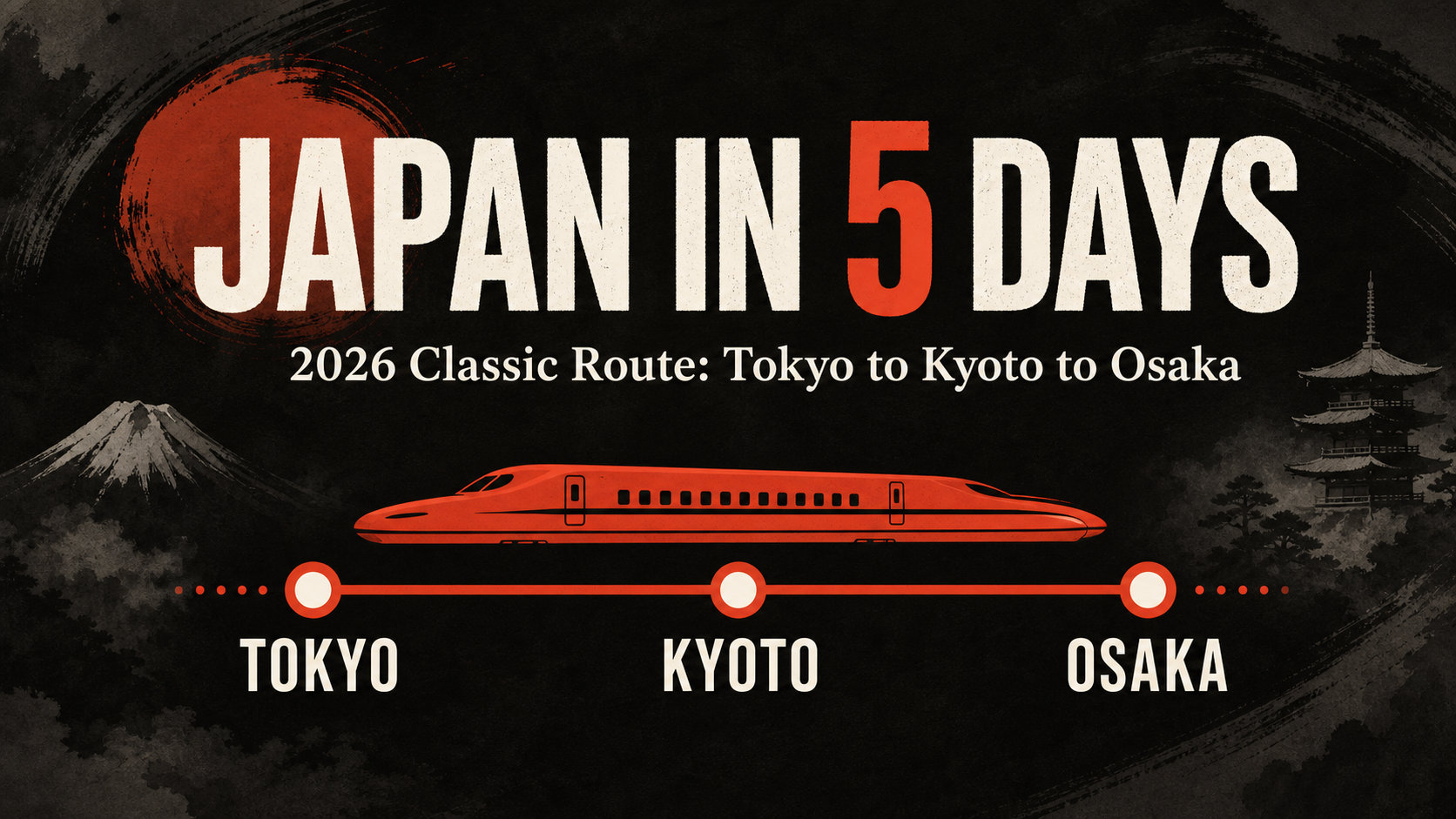
Japan 5-Day Itinerary: Tokyo, Kyoto & Osaka (The Classic Route, Optimized for 2026)
Five days in Japan is tight but absolutely doable. This itinerary routes you through Tokyo, the Shinkansen corridor, Kyoto, and Osaka — with every transport link, booking tip, and cultural moment planned so you don't waste a minute.
Japan rewards planning. Not obsessive minute-by-minute scheduling — Japan's public transit is too reliable and too good for that — but thoughtful sequencing. The difference between a chaotic 5-day sprint and a genuinely memorable trip usually comes down to three things: getting the city order right, booking the two or three things that actually require advance reservations, and leaving enough flexibility for the moments you didn't plan.
This itinerary gives you the Tokyo–Kyoto–Osaka classic route structured for a 5-day trip. We've built it to minimize backtracking, maximize variety, and front-load the booking decisions you need to make early.
Before You Go: The Pre-Departure Checklist
Before we get into the day-by-day plan, here's what to sort out before you board your plane:
Book These Early (Months Ahead in Peak Season)
- teamLab Borderless or teamLab Planets (Tokyo) — timed entry, sells out fast. Check borderless.teamlab.art for current availability and pricing
- Ryokan in Kyoto — the best properties book up 2–4 months ahead during cherry blossom and autumn foliage season
- Shinkansen reserved seats — not strictly necessary (unreserved cars exist) but highly recommended for busy periods. If you have a JR Pass, reserve seats free of charge at a JR Ticket Office on arrival. If buying individual tickets, reserve via JR's official site or at a station machine — see our JR Pass guide for which is better for your route
Book 1–2 Weeks Ahead
- Popular ramen or sushi restaurants — some require reservations and have waitlists
- Experiences on Klook/GetYourGuide — tea ceremonies, sumo experience, Nara deer tours: Klook Japan
- Accommodation in Tokyo and Osaka — off-peak, a week is fine; peak season, book earlier
Sort Before Departure
- eSIM or data SIM — buy and install before you board. Airalo Japan plans are a reliable starting point — see our Japan eSIM guide for a full comparison
- IC card — a Suica or ICOCA card works on nearly all transit in Japan. If you have an iPhone (iOS 16+) you can add Suica to your Apple Wallet before departure
- Cash — Japan is still significantly cash-dependent at smaller restaurants, temples, and rural shops. Withdraw at 7-Eleven ATMs (accepts international cards); see our Japan travel money guide
- JR Pass decision — see our JR Pass guide and run the numbers for your route before purchasing
Day 1: Tokyo — East Side (Asakusa, Akihabara, Ueno)
Base: Tokyo (arrive morning/afternoon on Day 1, or evening before)
Theme: Old Tokyo meets modern otaku culture
Morning: Asakusa and Senso-ji
Land at Narita or Haneda, transit into the city (Narita Express or Limousine Bus to central Tokyo; check current schedules and prices at the airport), and check in to your hotel. If you're arriving in the morning, drop bags and head to Asakusa.
Senso-ji Temple is the most visited temple in Japan — and for good reason. The Nakamise shopping street leading to the main gate is lined with street snacks (ningyo-yaki fish-shaped cakes, kaminariokoshi rice crackers) and traditional souvenirs. The temple complex itself is free to enter and remarkable even with crowds. Arrive before 9 AM to see it relatively calm.
Afternoon: Akihabara Electric Town
A 10-minute train ride from Asakusa on the Tsukuba Express or a short walk/transit puts you in Akihabara. Even if you're not a collector, an hour walking through the district's layered shops and neon chaos is a genuine cultural experience. Collectors should set aside 3–4 hours minimum. See our Akihabara guide for the full breakdown.
Evening: Ueno or Asakusa Dinner
Return to the Asakusa/Ueno corridor for dinner. Ueno's Ameya-Yokocho market is a good spot for yakitori and casual Japanese food at reasonable prices. The area around Asakusa has dozens of traditional izakaya serving local Tokyo-style food.
Day 2: Tokyo — West Side (Shibuya, Harajuku, Shinjuku, teamLab)
Theme: Contemporary Tokyo, pop culture, world's busiest crossing
Morning: Shibuya Scramble and Harajuku
Start at Shibuya. The famous scramble crossing is at its most photogenic at rush hour (8–9 AM) or just before dusk. Shibuya Sky observatory offers panoramic Tokyo views — check current reservation requirements and pricing on the official site.
From Shibuya, walk or take one stop to Harajuku. Takeshita Street is the center of youth fashion and kawaii culture — accessible, affordable, and genuinely unlike anywhere else. Meiji Shrine is a 5-minute walk from Harajuku Station and offers a dramatically peaceful contrast: towering torii, forested walking paths, and a serene inner compound.
Afternoon: teamLab (Pre-Booked)
teamLab Borderless (re-opened at Azabudai Hills — check current location on the official teamLab site) or teamLab Planets (Toyosu) are among the most remarkable contemporary art experiences in the world. Both require advance timed-entry tickets and regularly sell out. Book as early as possible — check current availability and pricing on the official teamLab site. Set aside 2–3 hours.
Evening: Shinjuku
Shinjuku at night is an experience unto itself. The Golden Gai alley of tiny bars, the Omoide Yokocho "Memory Lane" yakitori alley, and the broader Kabukicho entertainment district are all within walking distance of each other. This is Tokyo at its most cinematic. Shinjuku is also one of the best neighborhoods for ramen — multiple highly-rated shops operate in the area.
Day 3: Tokyo → Kyoto by Shinkansen + Fushimi Inari
Logistics: Tokaido Shinkansen (Nozomi or Hikari) from Tokyo Station or Shinagawa → Kyoto. Check current schedules on JR's official site or Navitime. Journey approximately 2 hours 15 minutes (Nozomi) to 2 hours 40 minutes (Hikari). Note: JR Pass does not cover Nozomi trains — Hikari is the fastest JR Pass option.
Base: Kyoto
Morning: Board the Shinkansen
Even the Shinkansen itself is memorable for first-timers — the platform precision, the speed, and (on a clear day) the appearance of Mount Fuji on your left roughly 40 minutes after departing Tokyo. Check current viewing conditions for the window seats (right side heading to Kyoto for Fuji views).
Aim to depart by 8–9 AM to arrive in Kyoto by late morning, leaving the afternoon free.
Afternoon: Fushimi Inari Taisha
Fushimi Inari is 5 minutes from Kyoto Station by local JR train — one of the easiest temple trips in Japan. The thousands of vermilion torii gates winding up the forested hillside are iconic for good reason. The lower section (the most photographed stretches near the main shrine) gets crowded; hiking to the summit (2–3 hours round trip) thins the crowds dramatically.
There is no entry fee to walk the grounds. Arrive before 10 AM or after 4 PM for fewer crowds.
Evening: Gion and Pontocho
Walk the stone-paved alleys of Higashiyama and Gion at dusk — this is one of Japan's most atmospheric evening experiences. Pontocho, the narrow alley of restaurants along the Kamo River, is excellent for dinner. Advance reservations are wise for specific restaurants, but walk-ins are possible at less formal establishments.
See our Kyoto area guide for where to base yourself tonight.
Day 4: Kyoto Deep — Arashiyama, Kinkakuji, Downtown
Theme: Kyoto's greatest hits, one full day
Morning: Arashiyama Bamboo Grove
Take the Sagano Line (or a taxi — check current transit options) to Arashiyama. Arrive before 8 AM if possible — the bamboo grove is genuinely quiet in the early morning. The larger Arashiyama area (Tenryuji Garden, the Oi River, Nonomiya Shrine, monkey park) rewards 2–3 hours.
Late Morning: Kinkakuji (Golden Pavilion)
A taxi or bus from Arashiyama gets you to Kinkakuji in 20–30 minutes. The Golden Pavilion — a Zen temple pavilion covered in gold leaf, reflected in a still pond — is one of Japan's most reproduced images and does not disappoint in person. Entry fee applies; check current pricing at the gate. No advance reservation required as of this writing, but confirm on the official Kinkakuji website before visiting.
Afternoon: Nishiki Market and Central Kyoto
Return to central Kyoto for Nishiki Market — a narrow indoor food arcade known as "Kyoto's Kitchen." Sample pickled vegetables, tofu, fresh-grilled skewers, and regional specialties. This is one of the best spots for food souvenirs in Kyoto.
Nearby Teramachi Street and Shinkyogoku have gift shops, traditional craft stores, and casual restaurants. Good for the omiyage (souvenir gift) shopping that is a central ritual of Japanese travel.
Evening: Depending on Your Base
If staying in Gion, an evening stroll along Shirakawa canal and the Gion Shijo area is beautiful. If your appetite allows, a kaiseki dinner (traditional Japanese multi-course cuisine) is worth experiencing in Kyoto at least once — current pricing varies widely from modest to luxury. Book ahead for a formal kaiseki restaurant; more casual versions exist at reasonable prices.
Day 5: Osaka — Dotonbori, Namba, and Departure
Logistics: Kyoto → Osaka by JR Rapid (approximately 15–28 minutes, depending on service) or Hankyu (approximately 43 minutes from Kyoto Kawaramachi). Check current services and fares. Osaka is a logical departure city for those flying out of Kansai International Airport (KIX) — check your return flight's departure airport when booking.
Base: Osaka (or day trip from Kyoto)
Morning: Arrive and Check In
Depending on checkout from Kyoto and check-in at Osaka, you may have a luggage gap — most hotels allow bag storage before check-in. Store bags and head straight to Osaka's highlights.
Late Morning: Osaka Castle
Osaka Castle and its surrounding park are a 15-minute walk from Osaka-jo Koen subway station. The castle exterior and park grounds are photogenic and free to roam; the castle keep has an entry fee and a museum inside (check current hours and pricing on the official Osaka Castle website). Morning light hits the tower particularly well.
Afternoon: Dotonbori and Kuromon Market
Dotonbori is the food and entertainment heart of Osaka. Walk the canal, photograph the Glico sign, and eat your way through the street food corridor:
- Takoyaki (octopus balls) — Osaka's most famous street food
- Kushikatsu (deep-fried skewers) — especially in the retro Shinsekai district nearby
- Ramen and okonomiyaki — multiple excellent options in the Namba area
Kuromon Ichiba Market (Osaka's kitchen) is a short walk north of Dotonbori — stalls selling fresh seafood, sashimi, pickles, and snacks. Best visited in the late morning before closures.
Shinsaibashi shopping arcade runs from Dotonbori north — good for last-minute shopping, Japanese drugstore finds (sunscreen, skincare), and department store food basements (depachika) if you want high-quality omiyage.
Evening: Departure
For Kansai Airport (KIX), take the Nankai Rapid (non-reserved, approx. 45 minutes) or the Haruka Ltd. Express from Shin-Osaka or Tennoji (check current schedules and JR Pass compatibility). For flights from Osaka Itami (domestic hub), check current airport bus options from Umeda or Namba. Confirm transit times to your departure airport before committing to an evening activity.
If you have a late flight, a sunset drink from a rooftop bar in Umeda (Osaka Station area has several) is a good final image to carry home.
Extending to 7 Days or 10 Days
Five days leaves significant Japan unlocked. Here are the most natural extensions:
Add Hakone (1–2 nights between Tokyo and Kyoto)
Hakone offers Mount Fuji views, volcanic landscapes, open-air art museums, and onsen ryokan. Insert between Day 2 and Day 3 via Romancecar from Shinjuku.
Add Hiroshima and Miyajima (day trip from Osaka)
The Peace Memorial Museum and Itsukushima Shrine (floating torii gate) are reachable from Osaka on a long day trip — Shinkansen takes approximately 45 minutes each way.
Add Nara (half-day from Osaka or Kyoto)
Free-roaming deer, Todaiji's giant bronze Buddha, and Kasuga-taisha shrine are all walkable from Nara Station — 45–60 minutes from either city.
Frequently Asked Questions
Q: Is 5 days enough for Japan? Five days gives you a genuine, meaningful first experience of Japan — enough to feel the Tokyo–Kyoto–Osaka contrast and have several outstanding moments. It's not enough for everything, but most people leave Japan already planning their return. If you can extend to 7 days, add Hakone (for Mount Fuji views) or Hiroshima. See the extension options above.
Q: How much does a 5-day Japan trip cost? Total costs vary dramatically based on accommodation tier, dining choices, and activities. Budget travelers in hostels eating convenience store meals can keep costs lower; mid-range travelers with sit-down restaurants and business hotels spend more; luxury travelers significantly more. Accommodation, the Shinkansen, and activities are the three biggest budget items. Use our linked guides to compare current prices — we don't quote specific amounts as they date quickly.
Q: Should I buy a JR Pass for a 5-day Tokyo–Kyoto–Osaka trip? The JR Pass often does not break even on a strict Tokyo–Kyoto–Osaka route. The calculation depends on current pass prices and current single-ticket Shinkansen fares — both change. Use our dedicated JR Pass Worth It guide (with fare comparison table) to run the numbers for your specific itinerary before buying.
Q: What should I do if my time is even shorter — 3 or 4 days? With 3–4 days, prioritize ruthlessly. Option A: spend all days in Tokyo — it's dense enough to fill a week on its own. Option B: 2 nights Tokyo / 1–2 nights Kyoto, skip Osaka. Book the single experience you most want (teamLab, Fushimi Inari at sunrise) and let the rest develop organically. Quality beats quantity on short trips.
Summary: Your 5-Day Japan Blueprint
| Day | City | Key Experiences |
|---|---|---|
| Day 1 | Tokyo | Asakusa + Senso-ji, Akihabara, Ueno dinner |
| Day 2 | Tokyo | Shibuya Scramble, Harajuku, teamLab, Shinjuku night |
| Day 3 | Tokyo → Kyoto | Shinkansen (+ Fuji view), Fushimi Inari, Gion evening |
| Day 4 | Kyoto | Arashiyama + bamboo, Kinkakuji, Nishiki Market |
| Day 5 | Kyoto → Osaka | Osaka Castle, Dotonbori, Kuromon Market, depart from KIX |
Book early: teamLab, Shinkansen, Kyoto ryokan. Sort before departure: Japan eSIM, IC card, travel money, and the JR Pass decision.
Japan is one of the world's great travel destinations — efficient, safe, deeply generous with rewards for the curious, and unlike anywhere else. Five days is just enough to fall in love with it. Make them count.
Book & compare
This article contains affiliate links. If you book through them we may earn a commission at no extra cost to you. Prices and availability change — always confirm on the official site before booking.
Japan Rail Pass
JR Pass covers Shinkansen travel between Tokyo, Kyoto, and Osaka. Whether it's worth it depends on your specific route and days of travel — see our dedicated JR Pass guide for a cost comparison. Check current pricing on Klook's official page.
View on KlookteamLab Borderless Tokyo
Digital art museum experience requiring timed entry reservation. Extremely popular — book as early as possible, especially for peak travel periods. Check current availability and pricing on the official teamLab site.
View on teamLabKlook Japan Experiences
Book day trips, tours, tea ceremonies, sumo, and other experiences across Japan. Prices and availability vary — check the official Klook site for current offers.
View on KlookGetYourGuide Japan Tours
Alternative to Klook for guided tours and experiences. Good for English-guided cultural experiences. Check current pricing and availability.
View on GetYourGuideOsaka Hotels on Booking.com
Compare Osaka hotels across all neighborhoods. Check current prices and availability before booking.
View on Booking.comKyoto Hotels on Booking.com
Wide selection of Kyoto hotels, guesthouses, and ryokan. Prices vary significantly by season. Always check current rates.
View on Booking.comAiralo Japan eSIM
Stay connected across all three cities. Purchase before departure for the easiest activation. Check current plans and pricing on the official Airalo site.
View on AiraloBuyee Japan Proxy Buying
For Akihabara or Japan shopping beyond your trip — access Yahoo! Auctions Japan and domestic shops from overseas. Check current fees on the official site.
View on Buyee