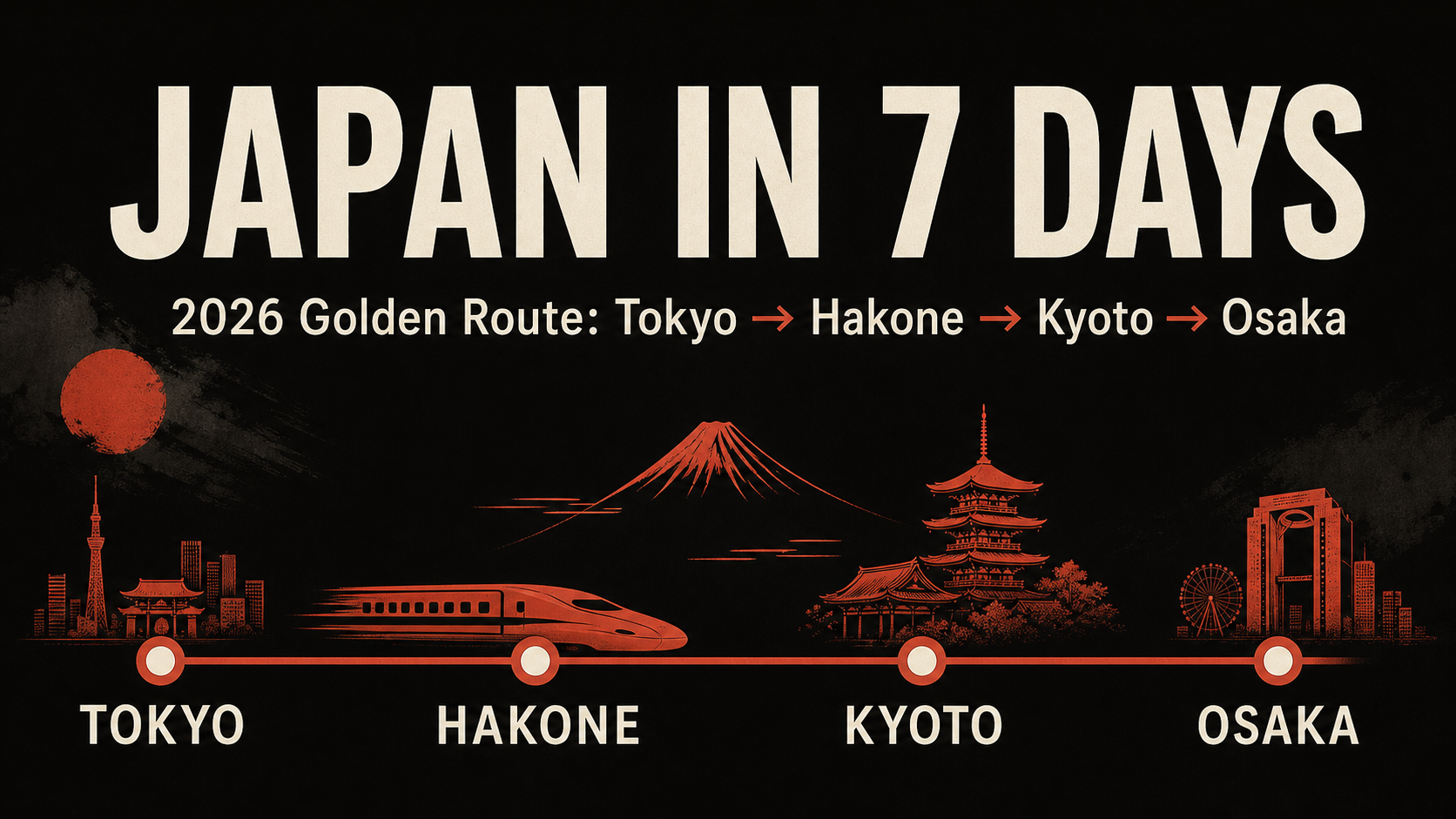
Japan 7-Day Itinerary: The First-Timer Golden Route (Tokyo, Hakone/Fuji, Kyoto, Osaka — 2026)
Seven days is the sweet spot for a first trip to Japan. This day-by-day plan runs the Golden Route — Tokyo, Hakone for Mount Fuji, Kyoto, and Osaka — with every Shinkansen connection, where to sleep each night, what to prebook, plus foodie and with-kids variations.
Seven days is the number most experienced travelers name when a first-timer asks how long to spend in Japan. Five days is genuinely doable but leaves you moving almost every day. Ten days is luxurious but hard for many people to take off work. Seven hits the balance: it covers the classic Golden Route — Tokyo, the Mount Fuji region, Kyoto, and Osaka — with enough breathing room for one restful onsen night and a proper two days in Kyoto.
This itinerary is built around three principles that separate a smooth week from a stressful one. First, get the direction right so you never double back: land in Tokyo, work west, and fly out of Osaka's Kansai Airport. Second, book only the handful of things that truly require advance reservations — Japan's transit and most of its sights don't need it, but a few do, and they're the ones that ruin a day if you miss them. Third, build in one slow day — the Hakone ryokan night — so the trip has a rest point rather than being seven days of sightseeing at full throttle.
Below you'll find the day-by-day plan, the exact transport move between each city, where to sleep each night, a copy-ready 7-day table, a booking checklist, and three alternate 7-day themes: first-timer (the default), foodie, and with-kids.
The 7-Day Golden Route at a Glance
| Day | Base city (night) | Headline experiences | Transport move | Prebook? |
|---|---|---|---|---|
| Day 1 | Tokyo | Arrive, Asakusa + Senso-ji, Akihabara, Ueno dinner | Airport → central Tokyo (N'EX / Limousine Bus / Keisei) | Hotel only |
| Day 2 | Tokyo | Shibuya Scramble, Harajuku + Meiji Shrine, teamLab, Shinjuku night | Local trains / metro (IC card) | teamLab (timed entry) |
| Day 3 | Hakone | Fuji views, Open-Air Museum, Owakudani, Lake Ashi, onsen ryokan | Odakyu Romancecar Shinjuku → Hakone-Yumoto | Onsen ryokan |
| Day 4 | Kyoto | Fushimi Inari, Gion + Pontocho evening | Hakone → Odawara → Shinkansen → Kyoto | Shinkansen seat (peak) |
| Day 5 | Kyoto | Arashiyama bamboo, Kinkakuji, Nishiki Market | Local trains / bus (IC card) | No (temples walk-in) |
| Day 6 | Osaka | Osaka Castle, Dotonbori, Kuromon Market, Shinsaibashi | Kyoto → Osaka (JR Rapid or Hankyu) | Hotel only |
| Day 7 | (day trip) | Option A: Nara half-day · Option B: Hiroshima + Miyajima · then depart | Kintetsu/JR to Nara, or Shinkansen to Hiroshima; then to KIX | Depends on option |
Read the table top to bottom before you book anything — the "Prebook?" column is the short list of things that need a reservation weeks ahead. Everything without a flag can be decided the day before or on the day.
Before You Go: The Pre-Departure Checklist
Sort these before you board your flight — they're the same essentials whether you run the first-timer, foodie, or with-kids version:
Book These Early (Months Ahead in Peak Season)
- teamLab Borderless or teamLab Planets (Tokyo) — timed entry, sells out fast. This is the single most common "we couldn't get in" regret. Check the official teamLab site for current availability and rates.
- Your Hakone onsen ryokan — the good rooms are limited and book out months ahead during autumn foliage and cherry-blossom season. This is the trip's one restful night, so it's worth locking in early. Compare properties on Expedia and check current rates.
- Kyoto accommodation — Kyoto's best machiya townhouses and ryokan fill 2–4 months ahead in peak season. Book before Tokyo if you're travelling in spring or autumn.
- Shinkansen reserved seats (peak periods) — not strictly required, but reserving avoids standing on packed holiday trains. With a JR Pass you reserve free at a JR Ticket Office; buying tickets individually, reserve online or at a station machine.
Book 1–2 Weeks Ahead
- Popular ramen, sushi, or kaiseki counters — some require reservations and keep waitlists.
- Guided experiences — tea ceremonies, a Hakone pass, Nara deer tours, cooking classes: browse Klook or KKday and check current rates.
- Osaka and Tokyo hotels — off-peak a week is fine; in peak season, earlier.
Sort Before Departure
- eSIM or data SIM — buy and install before you board so you have data the moment you land.
- IC card — a Suica or ICOCA card covers nearly all transit on the Golden Route. iPhone users (iOS 16+) can add Suica to Apple Wallet before departure.
- Cash — Japan is still cash-dependent at smaller restaurants, temples, and rural shops (including parts of Hakone). Withdraw at 7-Eleven ATMs, which accept international cards.
- JR Pass decision — see our JR Pass guide and run the numbers for your exact route, including whether you'll add the Hiroshima day trip, before buying. Fares and pass prices change; we don't quote amounts here.
Day 1: Tokyo — East Side (Asakusa, Akihabara, Ueno)
Base: Tokyo (night 1) Theme: Old Tokyo meets modern otaku culture — an easy first day for jet lag
Land at Narita or Haneda and transit into the city (Narita Express or Limousine Bus from Narita; monorail or Keikyu from Haneda — check current schedules and fares at the airport). Drop your bags at the hotel and, if you've arrived by early afternoon, head straight to Asakusa.
Senso-ji Temple is Tokyo's oldest and most visited temple. The Nakamise shopping street leading to the main gate is lined with street snacks — ningyo-yaki fish-shaped cakes, freshly grilled senbei rice crackers — and traditional souvenirs. The temple grounds are free and impressive even with crowds. A first evening here is forgiving: low-effort, high-reward, and walkable while you're fighting the time change.
In the afternoon, ride the Tsukuba Express a few minutes to Akihabara, the electronics and anime district. Even if you're not a collector, an hour among the layered shops and neon is a genuine culture hit; collectors should budget 3–4 hours.
For dinner, the Ueno/Asakusa corridor is full of casual options — Ueno's Ameya-Yokocho (Ameyoko) market is good for yakitori and cheap, lively Japanese food. Keep the first night early; you'll want the energy for Day 2.
Where to sleep tonight: a Tokyo base near a major JR/metro hub (Ueno, Tokyo Station, Shinjuku, or Shibuya) keeps both days efficient. See our Tokyo perfect day guide for neighborhood trade-offs.
Day 2: Tokyo — West Side (Shibuya, Harajuku, teamLab, Shinjuku)
Base: Tokyo (night 2) Theme: Contemporary Tokyo — pop culture, the world's busiest crossing, and digital art
Morning: start at Shibuya. The scramble crossing is most photogenic at rush hour or just before dusk; the Shibuya Sky observatory offers a panoramic view (check current reservation requirements). Walk or take one stop to Harajuku — Takeshita Street for youth fashion and kawaii culture, then a five-minute walk to Meiji Shrine, a serene forested contrast of towering torii and quiet gravel paths.
Afternoon: your prebooked teamLab slot (Borderless or Planets). These are among the most remarkable contemporary art experiences anywhere, they require timed-entry tickets, and they regularly sell out — which is why it's the one Tokyo thing to book weeks ahead. Set aside 2–3 hours.
Evening: Shinjuku. The Golden Gai warren of tiny bars, the Omoide Yokocho yakitori alley, and the Kabukicho district are all within walking distance of each other, and Shinjuku is one of Tokyo's best ramen neighborhoods. This is Tokyo at its most cinematic — a strong note to end the Tokyo leg on.
Pack tonight: tomorrow you move to Hakone, and you'll want a small overnight bag if you plan to forward your main luggage (see Day 3).
Day 3: Tokyo → Hakone by Romancecar (Mount Fuji, Onsen Ryokan)
Logistics: Odakyu Romancecar limited express from Shinjuku to Hakone-Yumoto (roughly 85 minutes; check current schedules and fares). The Odakyu Hakone Free Pass bundles the round trip plus unlimited local Hakone transport (mountain railway, cablecar, ropeway, sightseeing boat, buses) — usually the simplest way to do the Hakone loop; confirm current coverage and rates on the official Odakyu site or via Klook / KKday. Note: the Romancecar and the JR Pass are separate systems — a JR Pass does not cover this leg.
Base: Hakone (night 3 — the trip's one restful ryokan night)
Luggage tip: Hakone's ryokan and mountain transport aren't built for large suitcases. Use a luggage-forwarding service (takuhaibin, e.g. Yamato) to send your main bag from your Tokyo hotel ahead to your Kyoto or Osaka accommodation, and carry only an overnight bag into Hakone. Most hotels arrange this at the front desk; allow a day or two for delivery.
The Hakone loop (the Free Pass makes it a connected circuit): ride the switchback mountain railway up to Gora, the cablecar and ropeway over the volcanic valley of Owakudani (sulfur vents and, on a clear day, Mount Fuji), then the pirate sightseeing boat across Lake Ashi, with the Hakone Shrine's lakeside torii nearby. The Hakone Open-Air Museum — sculpture set against the mountains, with a Picasso pavilion — is a highlight worth 1.5–2 hours.
Evening: check into your onsen ryokan, soak in the hot spring, and have a multi-course kaiseki dinner in-house. This is the single most restorative night of the week — don't over-schedule it.
Fuji reality check: the mountain is famously shy and often hidden by cloud. Mornings, especially in the colder, clearer months, give you the best odds. Treat a Fuji sighting as a bonus, not a guarantee — Hakone rewards you either way.
Day 4: Hakone → Kyoto by Shinkansen + Fushimi Inari
Logistics: From Hakone, take the local train or bus down to Odawara Station, then the Tokaido Shinkansen (Hikari or Kodama; Nozomi is fastest but not JR-Pass-covered) to Kyoto — roughly 2 hours 10 minutes to 2 hours 40 minutes depending on service. Check current schedules and fares. Sitting on the correct side gives you another chance at Mount Fuji shortly after Odawara.
Base: Kyoto (night 4)
Aim to leave Hakone mid-morning after breakfast so you arrive in Kyoto by early afternoon. Drop bags (or collect the suitcase you forwarded on Day 3) and head out.
Afternoon: Fushimi Inari Taisha — five minutes from Kyoto Station on a local JR train, one of the easiest and most iconic temple visits in Japan. The thousands of vermilion torii gates winding up the hillside are the postcard image; the lower, most-photographed stretch gets crowded, but hiking toward the summit (2–3 hours round trip) thins the crowds fast. The grounds are free. Arrive before 10 AM or after 4 PM for fewer people — late afternoon on an arrival day works well.
Evening: Gion and Pontocho. Walk the stone-paved lanes of Higashiyama and Gion at dusk — one of Japan's most atmospheric evenings — then have dinner along Pontocho, the narrow lantern-lit alley beside the Kamo River. Reserve ahead for specific restaurants; walk-ins work at more casual spots.
Where to sleep tonight: see our Kyoto perfect day guide for whether to base yourself near the station, downtown (Kawaramachi), or in atmospheric Higashiyama.
Day 5: Kyoto Deep — Arashiyama, Kinkakuji, Nishiki Market
Base: Kyoto (night 5) Theme: Kyoto's greatest hits in one well-sequenced day
Early morning: Arashiyama. Take the Sagano/San-in Line to Arashiyama and reach the bamboo grove before 8 AM if you can — it's genuinely quiet then and mobbed by mid-morning. This "arrive early" move is the single biggest crowd-avoidance win in Kyoto. The wider Arashiyama area (Tenryuji temple garden, the Togetsukyo bridge, Nonomiya Shrine, the monkey park) rewards 2–3 hours.
Late morning: Kinkakuji (the Golden Pavilion). A bus or taxi across the city (20–30 minutes) reaches the gold-leaf Zen pavilion mirrored in its pond — one of Japan's most reproduced images, and one that holds up in person. There's an entry fee; check current pricing at the gate. No advance reservation is required as of writing, but confirm on the official site before you go.
Afternoon: Nishiki Market and downtown. Return to central Kyoto for Nishiki Market, the narrow covered arcade known as "Kyoto's Kitchen" — pickles, tofu, fresh-grilled skewers, and regional specialties, plus excellent food souvenirs. The adjacent Teramachi and Shinkyogoku arcades are good for craft shops and casual restaurants.
Evening: if you're staying in Higashiyama, a stroll along the Shirakawa canal in Gion is lovely. Kyoto is the place to try a kaiseki dinner at least once — reserve ahead for a formal restaurant, or find a more casual version at a gentler price.
Day 6: Kyoto → Osaka — Castle, Dotonbori, Kuromon Market
Logistics: Kyoto → Osaka is short — JR Special Rapid (about 15–30 minutes depending on service) or the Hankyu line (about 45 minutes from Kyoto Kawaramachi to Osaka Umeda). Check current services and fares. Because Osaka is your departure city, this short hop sets up an easy final day.
Base: Osaka (night 6)
Store bags at your Osaka hotel (most allow it before check-in) and head out.
Late morning: Osaka Castle — a 15-minute walk from Osaka-jo Koen station. The park grounds are free and photogenic; the reconstructed keep has an entry fee and a museum inside (check current hours and pricing on the official site).
Afternoon: Dotonbori and Kuromon. Dotonbori is Osaka's neon food-and-fun heart — walk the canal, photograph the Glico running-man sign, and eat your way along:
- Takoyaki (octopus balls) — Osaka's signature street food
- Kushikatsu (deep-fried skewers) — especially in the retro Shinsekai district nearby
- Okonomiyaki — the savory Osaka-style pancake
Kuromon Ichiba Market ("Osaka's kitchen"), a short walk north, sells fresh seafood, sashimi, and snacks — best in the late morning. The Shinsaibashi arcade runs north from Dotonbori for last-minute shopping, drugstore finds, and department-store depachika food halls for high-quality omiyage.
Evening: a rooftop drink in Umeda (Osaka Station area) is a good final-night image. See our Osaka perfect day guide for where to base yourself.
Day 7: Nara or Hiroshima — Then Depart
Base: day trip out and back, then fly home from Kansai International Airport (KIX)
Day 7 flexes to your flight time and appetite. Both options end at KIX, an easy transfer from central Osaka (Nankai Rapi:t or Nankai Airport line, or the JR Haruka limited express — check current schedules and JR Pass compatibility). Confirm your transit time to KIX before committing to the day's plan.
Option A: Nara (half-day — the relaxed choice)
Nara is 45–60 minutes from Osaka (Kintetsu or JR) or Kyoto. From Kintetsu Nara Station you can walk to Nara Park, where free-roaming deer bow for crackers, then to Todaiji, whose Great Buddha Hall houses a colossal bronze Buddha, and Kasuga-taisha shrine with its stone and bronze lanterns. A half-day covers the highlights and leaves the afternoon for your flight. Best for travelers with a midday or early-evening departure, or families who want a gentle final day.
Option B: Hiroshima + Miyajima (full day — the ambitious choice)
The Sanyo Shinkansen runs Osaka (Shin-Osaka) → Hiroshima in roughly 1.5 hours each way (check current schedules). Spend the morning at the Peace Memorial Park and Museum, then ferry to Miyajima for Itsukushima Shrine's famous "floating" torii gate. This is a long, rewarding day that pushes the JR Pass math in the pass's favor — but it needs an evening or next-morning flight, so only choose it if your departure is late or you've added an extra night. If you fly out midday on Day 7, take Nara instead.
If your flight is early on Day 7, skip the day trip entirely: use the morning for last shopping in Shinsaibashi or the Umeda depachika, then head to KIX.
📌 Save this — Your 7-Day Japan Blueprint & Booking Checklist
The plan (first-timer default):
- Nights: 2 Tokyo · 1 Hakone · 2 Kyoto · 1 Osaka (6 nights / 7 days)
- Direction: Fly into Tokyo (Narita/Haneda), out of Osaka (Kansai/KIX) — never backtrack
- Day 1 Tokyo East — Asakusa, Senso-ji, Akihabara, Ueno (hotel only)
- Day 2 Tokyo West — Shibuya, Harajuku, teamLab, Shinjuku (prebook teamLab)
- Day 3 → Hakone by Romancecar — Fuji, Open-Air Museum, onsen ryokan (prebook ryokan)
- Day 4 → Kyoto by Shinkansen — Fushimi Inari, Gion (reserve seat in peak season)
- Day 5 Kyoto — Arashiyama (before 8 AM), Kinkakuji, Nishiki Market
- Day 6 → Osaka — Osaka Castle, Dotonbori, Kuromon Market
- Day 7 Nara half-day or Hiroshima day trip, then depart from KIX
Booking checklist — do it in this order:
- Open-jaw flight (into Tokyo, out of Osaka/KIX)
- teamLab timed-entry ticket (weeks/months ahead)
- Hakone onsen ryokan (months ahead in peak season) — compare on Expedia
- Kyoto accommodation (2–4 months ahead in spring/autumn)
- Tokyo + Osaka hotels (1+ weeks; earlier in peak)
- JR Pass decision — run your route in our JR Pass guide
- Shinkansen reserved seats (peak periods)
- Any kaiseki / omakase dinner and popular ramen counters (1–2 weeks)
- Guided experiences — Klook / KKday
- eSIM, IC card (Suica/ICOCA), cash plan — before departure
- Luggage forwarding (Tokyo → Kyoto/Osaka) so Hakone is carry-on only
Leave flexible: most Kyoto temples, Nishiki & Kuromon markets, Dotonbori street food, walk-in izakaya. Fares and rates via official/booking sites — all change. Verified · updated 2026-07.
Alternate 7-Day Themes
The Golden Route above is the first-timer default. Two common variations reshape the same seven days without adding cost or complexity.
Theme 1: The Foodie 7 Days
Shift the trip's weight toward Osaka and Kyoto's kitchens. Keep 2 nights Tokyo but trade Hakone's ryokan night for a second Osaka night (2 Tokyo · 1 Kyoto-region · 3 Osaka is one version; or keep 2 Kyoto and give Osaka 2 nights). What changes day to day:
- Tokyo: swap one sightseeing block for Tsukiji Outer Market in the morning (sushi breakfast, tamagoyaki, knives) and a Shinjuku or Ebisu ramen/izakaya crawl at night.
- Kyoto: make Nishiki Market a longer, deliberate grazing session, and book one kaiseki dinner — Kyoto is the place for it.
- Osaka: this is the payoff. A proper Dotonbori + Shinsekai kushikatsu night, a Kuromon Market morning, and an okonomiyaki/takoyaki deep dive. Consider a guided food tour or an okonomiyaki cooking class via Klook or KKday.
- Day trip: replace Nara/Hiroshima with Nara's mochi and Kyoto tea, or a Kobe beef lunch (Kobe is ~30 minutes from Osaka). Reserve top counters 1–2 weeks ahead.
Theme 2: The With-Kids 7 Days
Prioritize fewer moves, more space to run, and shorter transit legs. The biggest change: consider dropping the Hakone ryokan night (kaiseki and quiet onsen etiquette can be hard with small children) in favor of a calmer second Tokyo base or a theme-park day.
- Tokyo: keep Asakusa and teamLab (kids love teamLab), and add Ueno Zoo or an easy park morning. If your family wants a theme park, Tokyo Disney Resort or a Ghibli attraction can replace a Hakone night — book those far ahead.
- Transit: favor fewer city changes and reserve Shinkansen seats so everyone sits together. Luggage forwarding is even more valuable with kids — send bags ahead so you travel light.
- Kyoto: Fushimi Inari (climbing the torii tunnels is a hit), Arashiyama (bamboo grove plus the monkey park), and the Kyoto Railway Museum near the station on a rainy day.
- Osaka: Universal Studios Japan is the marquee kids' day (prebook Express Passes), or the Osaka Aquarium Kaiyukan. Dotonbori's street food is famously kid-friendly.
- Day 7: Nara's deer are the single best "with-kids" finale in this whole itinerary — gentle, memorable, and a short hop from Osaka before your flight.
Compare hotels and family rooms across all four cities on Expedia, and check current rates before booking.
What Most Guides Get Wrong About the 7-Day Route
A few honest corrections that will save you time and money:
- Don't fly in and out of the same city. The most common first-timer mistake is a round-trip into Tokyo, which forces a wasted backtracking leg from Osaka. An open-jaw flight (in Tokyo, out Osaka/KIX) costs about the same and saves a whole day.
- Don't assume the JR Pass is automatically worth it. On a Tokyo–Hakone–Kyoto–Osaka core it's genuinely borderline, and it doesn't cover the Romancecar to Hakone or Nozomi trains. It usually only wins if you add the Hiroshima day trip. Run your exact route in our JR Pass guide first.
- Don't drag a big suitcase into Hakone. Forward it Tokyo → Kyoto/Osaka and travel to Hakone with an overnight bag — the mountain trains and ryokan aren't built for large luggage.
- Don't schedule Fuji as a certainty. Cloud hides it often. Go to Hakone for the whole experience — onsen, art, the volcanic loop — and treat a clear Fuji as a bonus.
- Don't over-plan the ryokan night. It's the trip's rest point. Arrive, soak, eat, sleep. The temptation to cram a third Hakone attraction is what turns a restorative night into a rushed one.
- Don't do Hiroshima with an early Day 7 flight. It's a long day each way — great with an evening departure, a mistake with a midday one. Take Nara instead when time is tight.
Frequently Asked Questions
Q: Is 7 days enough for Japan? Seven days is the sweet spot for a first trip. It gives you Tokyo's density, a Hakone night for Mount Fuji and an onsen ryokan, Kyoto's temples and Gion, and Osaka's food — the full Golden Route contrast without a rushed one-night-per-city sprint. You won't see everything (Hokkaido, the Alps, and Kyushu will wait), but a week is long enough to feel you experienced Japan. If you must choose one add-on, Hakone gives the biggest change of scenery.
Q: What's the difference between a 5-day and a 7-day Japan itinerary? The two extra days let you add Hakone between Tokyo and Kyoto and give Kyoto a proper two nights. On a 5-day trip you move almost daily and skip the Fuji region; on 7 days you get one restful ryokan night and unrushed Kyoto time.
Q: Should I buy a JR Pass for a 7-day Golden Route trip? Closer than on five days, but still not automatic. The 7-day pass may or may not out-price individual tickets on a Tokyo–Kyoto–Osaka core with one Hakone detour — both pass and fare levels change. Adding a Hiroshima day trip pushes it toward the pass. Note it covers neither Nozomi nor the Odakyu Romancecar. Run your route in our JR Pass guide.
Q: In which order should I do the Golden Route? Most first-timers go Tokyo → Hakone → Kyoto → Osaka, flying into Tokyo and out of Kansai (KIX) so they never backtrack. Reverse the whole plan if your flights are the opposite. Book an open-jaw (multi-city) flight to save a full backtracking day.
Q: How many nights should I spend in each city? The balanced first-timer split is 2 Tokyo · 1 Hakone · 2 Kyoto · 1 Osaka. That front-loads Tokyo while you're energetic, gives Hakone its one ryokan night, and lets Kyoto breathe. Foodies shift a night to Osaka; families often drop the Hakone ryokan for a calmer base. See the alternate themes above.
Q: What should I prebook, and what can I leave flexible? Book well ahead: teamLab, your Hakone ryokan, Kyoto accommodation, and any specific kaiseki/omakase dinner. Book 1–2 weeks ahead: Shinkansen seats in peak season, popular ramen counters, guided experiences on Klook or KKday. Leave flexible: most Kyoto temples, markets, Dotonbori street food, and walk-in izakaya. See the Save-this box above.
Summary: Your 7-Day Japan Blueprint
| Day | City (night) | Key experiences | Transport |
|---|---|---|---|
| Day 1 | Tokyo | Asakusa + Senso-ji, Akihabara, Ueno dinner | Airport → central Tokyo |
| Day 2 | Tokyo | Shibuya, Harajuku, teamLab, Shinjuku night | Metro / IC card |
| Day 3 | Hakone | Fuji, Open-Air Museum, Owakudani, onsen ryokan | Romancecar from Shinjuku |
| Day 4 | Kyoto | Shinkansen (+ Fuji view), Fushimi Inari, Gion | Odawara → Shinkansen → Kyoto |
| Day 5 | Kyoto | Arashiyama + bamboo, Kinkakuji, Nishiki Market | Local trains / bus |
| Day 6 | Osaka | Osaka Castle, Dotonbori, Kuromon Market | JR Rapid or Hankyu |
| Day 7 | Nara or Hiroshima | Deer + Todaiji, or Peace Park + Miyajima, then depart | Local train / Shinkansen → KIX |
Seven days is enough to run the whole Golden Route and still have one slow, restorative night in the mountains. Get the direction right, book the short list that needs booking, forward your luggage past Hakone, and leave room for the moments you didn't plan. Fares, rates, and availability change — check official and booking sites before you commit. Verified · updated 2026-07.
If a week isn't in the cards, our 5-day itinerary tightens the same route; if this is your very first trip, start with first time in Japan for the fundamentals. Then make your seven days count.
Book & compare
This article contains affiliate links. If you book through them we may earn a commission at no extra cost to you. Prices and availability change — always confirm on the official site before booking.
Japan Rail Pass & Rail Tickets
The JR Pass covers Shinkansen travel between the Golden Route cities, but whether it breaks even depends on your exact route and travel days. See our dedicated JR Pass guide for a cost comparison, and check current pricing on Klook's official site.
View on KlookKlook Japan Experiences
Book day trips, tours, tea ceremonies, Hakone passes, and other experiences across the Golden Route. Prices and availability vary — check current rates on the official Klook site.
View on KlookGolden Route Hotels on Expedia
Compare hotels and ryokan across Tokyo, Hakone, Kyoto, and Osaka in one place. Rates change constantly by season — always check current prices and availability on the official Expedia site before booking.
View on ExpediaKKday Japan Tours & Passes
An alternative to Klook for Japan tours, regional passes, and experiences — sometimes with different inventory. Check current rates and availability on the official KKday site.
View on KKday