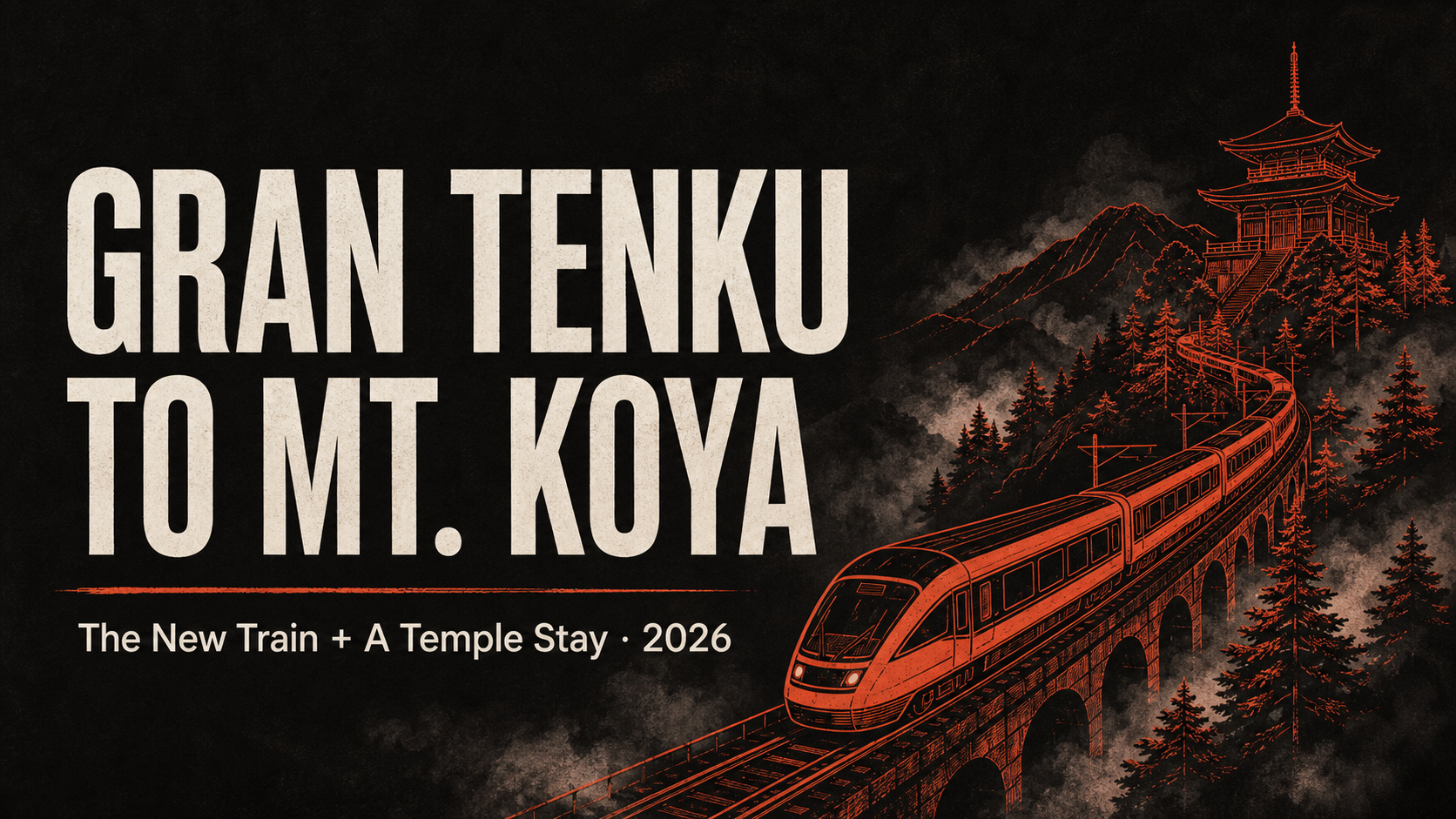
Gran Tenku: Japan's New Train to Mt. Koya — and How to Do a Temple Stay (2026)
Nankai's new Gran Tenku sightseeing train (launched April 2026) makes the climb to Mt. Koya an experience in itself. This is the complete plan: how to ride it, how a shukubo temple stay actually works, what to do at Okunoin after dark, and a tested 2-day itinerary from Osaka.
Note: The Gran Tenku timetable, reservations, fares, and temple-lodging rates all change and have limited capacity. Everything here is for orientation — verify current details on the official sites linked throughout. Verified and updated 2026-06.
Why Koyasan, and Why Now
Most first-time Japan itineraries are city-dense — Tokyo neon, Kyoto temples by day, Osaka street food. Koyasan is the opposite: a forested plateau at ~800 meters, ringed by eight peaks said to resemble a lotus flower, where 117 temples share a single small town and roughly 50 of them take overnight guests. Monks have been practicing here since the priest Kobo Daishi (Kukai) founded the complex in 816 AD. It's a UNESCO World Heritage Site, and unlike a museum-piece old town, it's a living one — you sleep where monks live and pray.
Why now: the journey just got better. Nankai retired its long-running "Tenku" observation train and launched Gran Tenku for the 2026 season — a premium sightseeing service built around the spectacular mountain section between Hashimoto and the cable-car base. The train turns the access — historically the dull part of a Koyasan trip — into a reason to go.
What most guides get wrong: they treat Koyasan as a half-day side trip from Osaka or Kyoto. It is not. Day-trippers see the temples in harsh midday light alongside tour buses and leave before the magic — the lantern-lit cemetery, the dawn fire ritual, the silence — even begins. Koyasan is an overnight or it's almost nothing.
Step 1: How to Get There from Osaka
📌 Save this — the access chain:
- Osaka (Namba) → board on the Nankai Koya Line. Two choices: the new Gran Tenku sightseeing train (scenic, reserved, limited runs) or the Limited Express "Koya" (faster, also reserved), or a regular express (no reservation, cheapest).
- Ride the climbing valley line up toward Gokurakubashi (roughly 80–100 minutes depending on service).
- At Gokurakubashi, transfer to the cable car (funicular) — a steep 5-minute ride up to the plateau.
- At Koyasan Station (the top), board the Nankai Rinkan bus into town (you generally cannot walk this stretch).
- Get off around Senjuinbashi (town center) or Okunoin-mae depending on your temple's location.
Buy the right ticket. The Koyasan-World Heritage Ticket bundles the round-trip Nankai train, the cable car, unlimited Koyasan buses, and discounts at attractions — for most visitors it's the simplest, best-value option. Note that the Gran Tenku and Limited Express require an additional limited-express/reservation fee on top. Verify the current price, what's included, and whether your chosen train needs a surcharge on the Nankai official site.
Reserving Gran Tenku. Because it's a sightseeing train with limited daily runs and assigned seats, reserve in advance — don't assume you can ride it on a whim, especially in autumn foliage season. Check the timetable and booking method on Nankai's site. If the Gran Tenku schedule doesn't fit your day, the Limited Express "Koya" gets you up comfortably, and a standard express works on a budget.
From Kyoto or Tokyo: route via Osaka. From Kyoto, reach Osaka/Namba first; from Tokyo, take the Shinkansen to Shin-Osaka, then to Namba. Note the JR Pass does not cover the Nankai Koya Line (Nankai is a private railway) — see our JR Pass guide for how that affects your math. For where to sleep on the Osaka side before/after, see Where to Stay in Osaka.
Step 2: The Shukubo (Temple Lodging) — How It Actually Works
This is the heart of the trip, so here's what genuinely happens, demystified.
What a shukubo is
A shukubo is lodging within a working Buddhist temple. You sleep in a tatami-mat room on a futon, share communal baths (often beautiful), and eat shojin-ryori — the refined vegetarian Buddhist cuisine with no meat, fish, onion, or garlic, built around tofu, seasonal vegetables, and Koyasan's famous goma-dofu (sesame tofu). It is not roughing it; many temples are centuries old with exquisite gardens, and the meals are a highlight, not a sacrifice.
The rhythm of a stay
- ~15:00 — Check in. Shoes off at the entrance. A monk or staff member shows you to your room and explains bath and meal times (these are fixed — you fit the temple's schedule, not the reverse).
- ~17:30 — Dinner. Shojin-ryori, often served in your room or a dining hall, beautifully plated on lacquerware.
- Evening — Okunoin after dark (see below) or the temple's own grounds. Then an early, quiet night.
- ~06:00 — Morning prayer service (otsutome). Guests are invited to attend the monks' chanting in the main hall; some temples include a goma fire ritual (a dramatic ceremonial fire burning prayer sticks). This is optional but unforgettable — set your alarm.
- ~07:30 — Breakfast. More shojin-ryori.
- Morning — Optional extras: some temples offer shakyo (tracing/copying a sutra with brush and ink) or meditation sessions before you explore the town.
Etiquette (read this before you arrive)
- Remove shoes at the entrance; slippers for halls, bare feet/socks for tatami.
- Keep your voice down — people are praying and resting; this is not a party hotel.
- Respect the fixed bath and meal times; latecomers may miss out.
- At the morning service, sit quietly, follow the monks' lead, photograph only if permitted, and never step in front of the altar.
- Tattoos: communal baths here are generally relaxed, but ask if unsure.
Booking the right way
Inventory is small and demand is high. Book through the Koyasan Shukubo Association, the temples' own pages, or OTAs such as Booking.com and Rakuten Travel — and book early (autumn foliage and Japanese holidays sell out months ahead). Rates typically include dinner and breakfast; confirm the meal plan and whether the morning service is offered when you reserve.
Insider edge — choosing a temple: temples near Okunoin (the eastern end of town) put you closest to the night cemetery walk; temples near the Danjo Garan / Kongobu-ji (the central temple complex) put you in the historical core. If the after-dark Okunoin experience is your priority, choose an eastern temple so the walk back is short. A few temples are known for especially renowned gardens or goma rituals — worth a search when you book.
Step 3: What to Do on the Mountain
Okunoin — and why night is the real visit
Okunoin is Japan's largest cemetery: a 2-kilometer path under towering centuries-old cedars, past more than 200,000 tombstones, memorials, and monuments, leading to the mausoleum of Kobo Daishi, who according to Shingon belief rests here in eternal meditation. At the Torodo (Hall of Lamps), thousands of lanterns burn continuously.
The locals' way: walk it after dark. Stone lanterns glow, the cedars disappear into blackness overhead, and the daytime tour groups are long gone. It's solemn and astonishing, not scary. Bring a light, stay on the path, keep silence (no photography is permitted in the most sacred inner area past the Gobyobashi bridge). Some temples and local guides run organized Okunoin night tours with historical and spiritual context — confirm current availability through your shukubo. (For comparison with other bookable Japan experiences, see our experiences guide.)
Danjo Garan and Konpon Daito
The Garan is the central temple compound Kobo Daishi laid out as the heart of the monastic complex. Its vermilion Konpon Daito pagoda is the signature image of Koyasan — visit in early morning light before the buses arrive.
Kongobu-ji
The head temple of Shingon Buddhism, with sliding-door paintings and Banryutei, the largest rock garden in Japan. The temple often serves a cup of tea with a sweet to visitors.
Daimon and the town
The Daimon great gate marks the historic entrance to the sacred precinct. The compact town between these sights is walkable, and the Koyasan bus connects the ends if you're tired.
A Tested 1-Night / 2-Day Itinerary from Osaka
📌 Save this — copy-paste Koyasan plan:
Day 1
- Morning: Depart Namba (Osaka) on the Gran Tenku (reserved) or Limited Express "Koya." Enjoy the valley climb.
- ~Midday: Cable car up + bus into town. Check into your shukubo, drop bags.
- Afternoon: Danjo Garan (Konpon Daito pagoda) and Kongobu-ji while the light is good.
- ~17:30: Shojin-ryori dinner at your temple.
- Evening: Okunoin night walk (lanterns lit; quiet, profound). Early night.
Day 2
- ~06:00: Morning prayer service (and goma fire ritual if offered) at your temple.
- ~07:30: Shojin-ryori breakfast.
- Morning: Optional sutra copying / meditation, then revisit Okunoin by day (different mood) or the Daimon gate.
- ~Late morning: Bus + cable car + Nankai back to Osaka.
- Afternoon: Back in Osaka by lunch/early afternoon — pair with Dotonbori or onward travel.
Should you stay 2 nights? Only if you want a genuine retreat — a second night lets you do a meditation session, copy a sutra unhurried, and walk Okunoin both at night and in dawn mist. For most travelers, one night is the sweet spot: enough for the full arc (dinner, cemetery, dawn service), without idle time. What to skip: don't try to also "do" a big Osaka day on your departure day if you have a Gran Tenku reservation to make in the morning — the mountain descent takes time.
Practicalities: What to Pack and Know Before You Climb
Koyasan is a mountaintop, not a city hotel, and a few logistics make or break the trip:
- Pack light for the mountain. You'll change trains, ride a cable car, and board a bus — and many shukubo have stairs and no elevators. Consider a forwarding service (takkyubin) to send your big suitcase ahead to your next city hotel and travel up with just an overnight bag. Most Osaka hotels and convenience stores can arrange same-day or next-day luggage forwarding; confirm current service and timing locally.
- Dress in layers. At ~800 meters, Koyasan is noticeably cooler than Osaka year-round — often by several degrees — and evenings are cold even in summer. In winter it snows. Bring a warm layer for the night Okunoin walk regardless of season.
- Carry cash. The town leans cash-friendly; smaller temples, the Okunoin offerings, snacks, and some shops may not take cards. Withdraw before you leave Osaka.
- Bring a flashlight or use your phone for the Okunoin night walk — the lanterns are atmospheric but the path is dark.
- Mind the last cable car and bus. Services up and down the mountain end earlier than you'd expect. If you arrive late or leave early, check the first and last departures on Nankai's site so you don't get stranded.
- Slippers and socks. You'll be barefoot or in socks on tatami and temple floors constantly — comfortable, easy-off shoes save endless fumbling.
Insider edge: Koyasan can be cold and wet when Osaka is warm and dry — travelers who pack only for the lowland cities are the ones shivering through the dawn service. Check the Koyasan-specific forecast, not Osaka's, before you go.
Who Should (and Shouldn't) Do This
In the spirit of honest travel advice:
- Do it if you want one genuinely different, contemplative night in an otherwise city-heavy Japan trip; if you're drawn to Buddhism, gardens, history, or simply silence; or if you've "done Kyoto" and want something the crowds haven't reached.
- Reconsider if you need Western-style hotel amenities (private en-suite bath, room service, late check-in, flexible meal times) — a shukubo is communal and runs on the temple's schedule. It's comfortable and beautiful, but it is not a resort.
- Manage expectations on food if you're a committed carnivore: shojin-ryori is entirely vegetarian (no meat, fish, onion, or garlic). Most travelers find it a revelation; a few miss a steak. Know which you are.
That honesty is the point: Koyasan rewards travelers who lean into its rhythm and underwhelms those expecting a hotel with a temple theme. Go for the experience, not the amenities.
Common Mistakes and How to Avoid Them
- Day-tripping. The biggest mistake. You'll see temples and miss Koyasan. Stay over.
- Not reserving the Gran Tenku. It's a limited-run sightseeing train with assigned seats — assuming walk-up availability can leave you on a slower train (or none). Reserve on Nankai.
- Booking the shukubo late. Small inventory + popular season = sold out. Book months ahead for autumn foliage and holidays via Booking.com or Rakuten Travel.
- Bringing card-only. The mountain town leans cash-friendly; carry yen for small temples, snacks, and incidentals.
- Sleeping through the 6 AM service. It's optional, but it's the experience you came for. Set an alarm.
- Treating a temple like a hotel. Fixed meal/bath times, lights-out quiet, and shoes-off respect are the deal. Embrace it — that's the point.
Frequently Asked Questions
What is the Gran Tenku and how is it different from the old Koyasan trains?
Gran Tenku is Nankai's new premium sightseeing train to Mt. Koya, introduced for 2026 to replace the long-running "Tenku" observation train with an upgraded experience on the scenic Hashimoto–Gokurakubashi mountain section. It emphasizes the views and the climb, typically requires a seat reservation, and runs on a limited schedule — check the current timetable and book on Nankai's site. For pure speed, the Limited Express "Koya" is the alternative.
Do I have to stay overnight on Mt. Koya, or can I day-trip?
You can day-trip, but you'd miss the point. Okunoin after dark, the 6 AM service, shojin-ryori meals, and the deep quiet only happen if you stay in a shukubo. An overnight is the single best reason to come. If you truly can't, prioritize Okunoin and the Garan and arrive in the late afternoon as crowds thin.
How do I book a shukubo temple lodging, and what's the etiquette?
Book through the Koyasan Shukubo Association, the temples' own pages, or OTAs like Booking.com and Rakuten Travel — early, since inventory is small. Rates usually include a vegetarian dinner and breakfast. Etiquette: shoes off, low voices, fixed bath and meal times, and quiet respect at the morning service. You're a guest in a working temple.
Is Okunoin safe and worth visiting at night?
Yes — the after-dark walk past lantern-lit cedars and over 200,000 memorials is the highlight for many. It's a sacred cemetery: be quiet and respectful, stay on the path, bring a light, and don't photograph the innermost sacred area. Some shukubo and guides run night tours with context — confirm availability locally.
Summary: Your Koyasan Blueprint
- Get there: Namba (Osaka) → Gran Tenku (reserve!) or Ltd Express "Koya" → cable car → bus. Buy the Koyasan-World Heritage Ticket; verify on Nankai.
- Sleep: a shukubo temple lodging with shojin-ryori — book early on Booking.com / Rakuten Travel.
- Do: Okunoin after dark, the Danjo Garan at dawn, Kongobu-ji, and the 6 AM prayer service.
- How long: 1 night is the sweet spot; 2 if you want a true retreat.
Koyasan is the calmest, most resonant night in Japan — and now the train ride up is worth the trip on its own. Craving more crowd-free, old-Japan escapes? See our hub guide, 7 Alternatives to Crowded Kyoto, and the elegant Kanazawa & Hokuriku coast. To slot Koyasan into a bigger trip, start from our 5-day Japan itinerary.
All schedules, fares, reservation rules, and lodging rates in this article are approximate and have limited capacity. Verify current details at the official sources linked throughout — especially the Gran Tenku timetable and shukubo availability. Information verified and updated 2026-06.
Book & compare
This article contains affiliate links. If you book through them we may earn a commission at no extra cost to you. Prices and availability change — always confirm on the official site before booking.
Koyasan temple lodging (shukubo) on Booking.com
Many of Koyasan's temple lodgings list rooms (with half-board shojin-ryori) here. Availability is limited and books out for peak seasons — check current rates and meal inclusions.
View on Booking.comKoyasan shukubo on Rakuten Travel
Often lists temple lodgings that Western OTAs miss. Confirm current price, dinner/breakfast inclusion, and any morning-service details on the listing.
View on Rakuten TravelNankai Railway / Koyasan-World Heritage Ticket
Official Nankai site for the Koya Line, the Gran Tenku and Limited Express Koya reservations, and the discount Koyasan-World Heritage Ticket (train + cable car + bus). Verify current fares, reservation rules, and the Gran Tenku timetable here.
View on Nankai Electric RailwayOsaka & Koyasan tours and tickets (Klook)
Day tours, transport tickets, and Osaka experiences to bookend your Koyasan trip. Compare current options and prices.
View on Klook