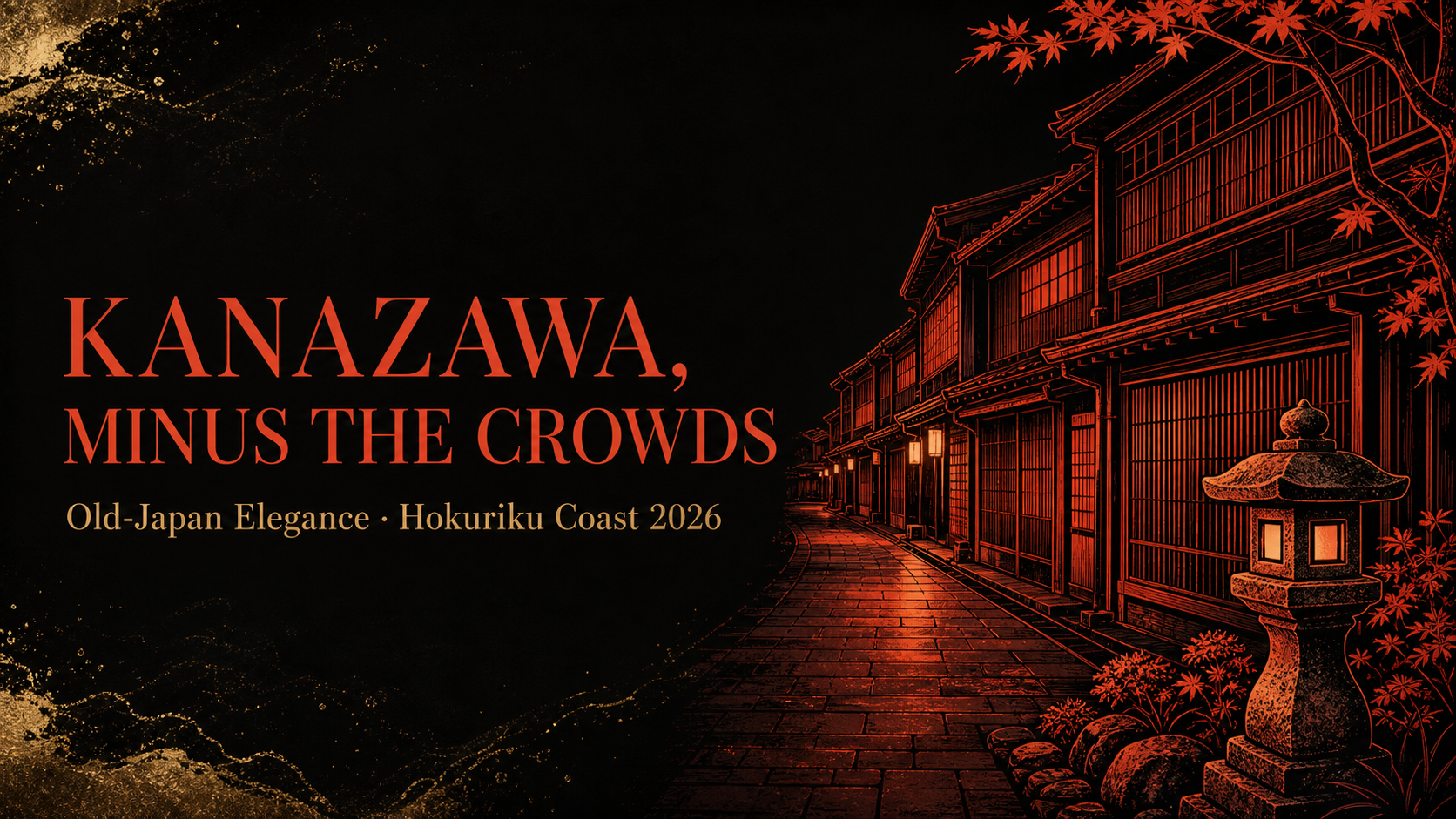
Kanazawa & the Hokuriku Coast: Old-Japan Elegance Without the Crowds (2026)
Kanazawa has the geisha districts, the samurai quarter, and one of Japan's three great gardens — but a fraction of Kyoto's crowds. With the Shinkansen now extended to Tsuruga, the whole Hokuriku coast is easier to loop than ever. Here's the full 2–3 day plan, the pass math, and where to sleep.
Note: Train schedules, pass prices, and accommodation rates change frequently and the 2024 Shinkansen extension altered some Kansai-side routings. Everything here is for orientation — verify current details at the official sources linked throughout. Verified and updated 2026-06.
Why Kanazawa Wins
Kanazawa was the seat of the wealthy Maeda clan, the second-richest feudal domain in Japan, and that old money built a city of refined arts — gold leaf, lacquerware, Kaga-yuzen silk dyeing, Noh theater, and tea culture. Crucially, Kanazawa escaped WWII bombing, so its Edo-era streets survive largely intact: not reconstructions, but the real wooden thing.
What you get is Kyoto's atmosphere without Kyoto's density — and it's stupidly easy to reach. The Hokuriku Shinkansen runs direct from Tokyo, so Kanazawa slots into a Golden Route trip without backtracking. (It's the top pick in our hub guide, 7 Alternatives to Crowded Kyoto.)
What most guides get wrong: they list Kanazawa's sights as if timing doesn't matter. It matters more than anything. Kanazawa's two crown jewels — Kenroku-en and Higashi Chaya-gai — fill with day-tour groups from roughly 11 AM to 3 PM and are nearly empty before 9 AM and after 5 PM. Stay one night and you can have both essentially to yourself at the golden hours. Day-trip and you'll fight crowds at exactly the wrong time.
Getting There (and the 2024 Tsuruga Change)
- From Tokyo: Hokuriku Shinkansen direct to Kanazawa, ~2.5–3 hours, no transfers. The easiest leg on this whole guide.
- From Kyoto/Osaka: Historically the Thunderbird limited express ran the whole way. Since the March 2024 Shinkansen extension to Tsuruga, the Kansai-side trip typically involves a transfer at Tsuruga (Thunderbird to Tsuruga, then Hokuriku Shinkansen onward). Times changed — check the current routing before you travel.
- Within the city: Kanazawa's sights cluster in walkable districts linked by the Kanazawa Loop Bus (and a flat-fare city center). IC cards work on most transit.
Pass note: The Hokuriku Arch Pass is built for the Tokyo → Kanazawa → Osaka arch. The national JR Pass also covers the Hokuriku Shinkansen if you already hold one. See the break-even table below and our JR Pass guide.
The 2-Day Kanazawa Itinerary
📌 Save this — copy-paste 2-day plan:
Day 1 — The Core
- Before 9 AM: Higashi Chaya-gai (eastern geisha district) — wooden teahouse facades and gold-leaf shops, empty and golden at dawn.
- At opening: Kenroku-en garden — beat the tour groups; pair with the adjacent Kanazawa Castle Park.
- Lunch: Omicho Market — snow crab (winter), sweet shrimp, kaisendon seafood bowls.
- Afternoon: 21st Century Museum of Contemporary Art (the "Swimming Pool" installation) — a fun modern contrast.
- Dusk: Optional return to Higashi Chaya-gai as lanterns come on and crowds vanish.
Day 2 — Craft & Quiet
- Morning: Nagamachi samurai district — earthen walls, the Nomura-ke residence and garden.
- Late morning: Gold-leaf craft experience — apply gold leaf to a small box or chopsticks (Kanazawa makes nearly all of Japan's gold leaf).
- Afternoon: Kazue-machi (riverside geisha lane) and Nishi Chaya-gai (the quietest geisha district), plus the Myoryuji "Ninja Temple" (reserve ahead — it requires a booking).
- Optional: D.T. Suzuki Museum for a meditative end to the day.
Insider edges baked into this plan:
- Kenroku-en at opening (or the last hour) is a different garden than midday — calm, with locals and good light.
- Myoryuji ("Ninja Temple") has hidden staircases and trapdoors and requires advance reservation by phone with timed tours — don't just show up.
- Kanazawa's geisha districts are best in this order of crowds: Higashi Chaya (busiest) → Kazue-machi → Nishi Chaya (quietest). For solitude, Nishi Chaya delivers.
- Gold-leaf ice cream (a soft-serve wrapped in a full sheet of edible gold) near Higashi Chaya is a fun, only-in-Kanazawa photo.
Eat: Kanazawa's Table
Kanazawa is a serious food city thanks to Sea of Japan seafood and old-money refinement.
- Omicho Market — the city's kitchen for snow crab (kano-gani, peak winter), sweet shrimp (amaebi), and kaisendon. Go for lunch; many stalls wind down by mid-afternoon.
- Kaga cuisine — the refined local style; jibuni (a thickened duck-and-vegetable stew) is the signature dish.
- Sushi — Kanazawa's sushi is a genuine destination in itself, fed by the local catch.
- Wagashi & matcha — Kanazawa is one of Japan's great tea-sweet cities; pause for matcha and a seasonal sweet in a teahouse.
Insider edge: snow crab has a defined season (roughly winter) and the prized local male crab is expensive — verify availability and don't expect it in summer. Reserve well-regarded sushi counters ahead.
Extend to 3 Days: The Hokuriku Coast
If you have a third day, the extended Shinkansen makes the coast easy:
- Kaga Onsen — a cluster of historic hot-spring towns (Yamashiro, Yamanaka, Awazu) with classic ryokan; a perfect onsen night.
- Wakura Onsen / Noto Peninsula — dramatic Sea of Japan coast and one of Japan's most storied seaside ryokan areas. Note: parts of the Noto Peninsula were affected by the January 2024 earthquake — check the current status of specific towns, roads, and inns before planning, as recovery is ongoing.
- Fukui — the Fukui Prefectural Dinosaur Museum (one of the world's best) and Eihei-ji, a major active Zen training temple where you can feel the same monastic calm as a Koyasan stay.
- Tsuruga — now the Shinkansen terminus; a logical hinge point toward Kansai.
For a contemplative overnight in the same spirit, compare the temple-stay experience in our Gran Tenku & Koyasan guide.
When to Go: A Season-by-Season Read
Kanazawa is genuinely a four-season city, but each season changes what you should prioritize:
- Spring (late March–April): Cherry blossoms ring Kanazawa Castle Park and parts of Kenroku-en, and the garden often opens for special free night illuminations during peak bloom — a quietly magical, much less crowded alternative to Kyoto's sakura crush. Bloom timing shifts yearly; track it with our cherry blossom & autumn leaves guide.
- Summer (June–August): Green and lively, but the Sea of Japan side is humid and sees a rainy spell in early summer. Festivals (including the Hyakumangoku Matsuri in early June, a grand procession honoring the Maeda lord's entry into the city) are the draw. Pack for rain.
- Autumn (October–November): Arguably the best all-rounder — Kenroku-en's foliage is spectacular, the air is crisp, and crab season is approaching. Book accommodation early; this is peak.
- Winter (December–February): The connoisseur's season. Kenroku-en's yukitsuri (rope cones rigged to protect pine branches from heavy snow) is the garden's most iconic image, and it's prime snow-crab season at Omicho Market. It's cold and snowy — but atmospheric and uncrowded. The garden's winter illumination evenings are a highlight if your dates line up.
Insider edge: Kanazawa's winter is the opposite of most travelers' instinct to avoid "cold" Japan — the yukitsuri garden and snow crab make it one of the most rewarding (and quietest) times to visit, provided you pack for snow.
Combining Kanazawa with the Rest of Your Trip
Because Kanazawa sits on the Hokuriku arch, it threads neatly into bigger routes:
- The crowd-free loop (7–10 days): Tokyo → Kanazawa (2 nights) → Kyoto (dawn highlights only) → Osaka. You get old-Japan elegance in Kanazawa and Kyoto's icons without spending all day in Kyoto's crowds. This is the loop our 5-day itinerary extends into when you add days.
- The garden grand slam: Kanazawa's Kenroku-en is one of Japan's "three great gardens" — pair it with Korakuen (Okayama) and Kairakuen (Mito) across a longer trip if landscape gardens are your thing.
- The contemplative pairing: combine Kanazawa's refined arts with a temple-stay night — either Eihei-ji (the Zen training temple near Fukui, on the same Hokuriku line) or, on the Kansai side of your loop, Koyasan (see our Gran Tenku & Koyasan guide).
What to skip when combining: resist cramming the entire Hokuriku coast (Kaga, Noto, Fukui, and Kanazawa) into a single trip unless you have a week for this region alone — the coastal legs run less frequently than the Shinkansen and eat time. Do Kanazawa properly with one well-chosen extension rather than a rushed sweep.
Where to Stay (by Traveler Type)
📌 Save this — pick your base:
| You are… | Best area | Why |
|---|---|---|
| First-timer wanting central + walkable | Korinbo / Katamachi | Between Kenroku-en, Nagamachi, and the chaya districts; shops and dining at hand |
| On a budget / efficient transit | Near Kanazawa Station | Newest hotels, easy Shinkansen and Loop Bus access, fair prices |
| Wanting atmosphere & old-Japan texture | Near Higashi Chaya-gai / the river | Wake up in the geisha-district quiet; dawn walks out your door |
| Wanting a traditional ryokan splurge | Kaga Onsen / Wakura Onsen (3-day plan) | Half-board kaiseki and hot springs; book the onsen night as a highlight |
Compare current rates by district on Booking.com; for traditional ryokan and the onsen towns, Rakuten Travel often has inventory Western OTAs miss. Confirm half-board meal plans when booking a ryokan. (For the Kyoto leg of a combined trip, see Where to Stay in Kyoto.)
Is the Hokuriku Arch Pass Worth It?
📌 Save this — the break-even table:
| Your itinerary | Hokuriku Arch Pass verdict |
|---|---|
| Tokyo → Kanazawa → Osaka (one-way loop) | Often worth it — this is exactly what it's designed for |
| Loop + side trips along the line (Tsuruga, Fukui, Kaga) | Strong value — you're using the coverage fully |
| Tokyo ↔ Kanazawa round-trip only (out-and-back) | Do the math — single Shinkansen tickets may be cheaper |
| Already buying a national JR Pass for a wider trip | Skip the Arch Pass — JR Pass covers the Hokuriku Shinkansen |
| Kansai-based, just dipping into Kanazawa | Compare — the post-2024 Tsuruga transfer changes the math |
The rule of thumb: the Hokuriku Arch Pass shines on the one-way arch with side trips, not on simple out-and-back trips. Because both the pass price and single Shinkansen fares change, always verify current prices and add up your single fares first — if they approach or exceed the pass, buy it. Check the Hokuriku Arch Pass and run the broader numbers in our JR Pass guide.
Common Mistakes to Avoid
- Day-tripping from Tokyo. You'll hit Kenroku-en and Higashi Chaya at their most crowded (midday) and miss the dawn/dusk magic. Stay at least one night.
- Ignoring the 2024 Tsuruga change. Kansai-side routing now usually means a transfer at Tsuruga — verify current schedules.
- Skipping a reservation for Myoryuji ("Ninja Temple"). It requires an advance phone booking and timed tour — you can't walk in.
- Expecting snow crab year-round. It's seasonal (roughly winter) and pricey — don't build a winter-only dish into a summer trip.
- Booking the wrong pass. The Arch Pass is for the loop; out-and-back travelers may do better on single tickets. Do the math.
- Underrating the weather. Kanazawa is on the Sea of Japan — more rain and snow than the Pacific side. Pack layers and a brolly; check the forecast.
Frequently Asked Questions
How do I get to Kanazawa, and how long does it take?
From Tokyo, the Hokuriku Shinkansen runs direct in ~2.5–3 hours with no transfers. From Kyoto/Osaka, take the Thunderbird toward the Hokuriku line — but since the 2024 Shinkansen extension to Tsuruga, the Kansai-side trip usually involves a transfer at Tsuruga, so check current routing and times. Verify schedules and whether the Hokuriku Arch Pass fits your plan.
Is two days enough for Kanazawa, or should I stay longer?
Two days (one to two nights) is the sweet spot for the core — geisha districts, Kenroku-en, the castle, Nagamachi, Omicho Market, and a gold-leaf experience. Add a third day for the Kaga Onsen towns, Fukui (dinosaur museum, Eihei-ji), or the Noto Peninsula. Staying over lets you catch Kenroku-en and Higashi Chaya at the quiet dawn and dusk hours that day-trippers miss.
Is the Hokuriku Arch Pass worth buying?
It depends on your route. It's designed for the Tokyo → Kanazawa → Osaka loop and often pays off there, especially with side trips. For an out-and-back from Tokyo, single tickets or a national JR Pass may be better. Prices change — run the numbers against your itinerary using the table above and our JR Pass guide.
When is the best time to visit Kanazawa?
Year-round, with seasonal signatures: autumn foliage at Kenroku-en, winter's yukitsuri rope cones and snow-crab season, and spring cherry blossoms around the castle. Being on the Sea of Japan side, Kanazawa sees more rain and snow than the Pacific coast — pack accordingly and check forecasts. See our cherry blossom & autumn leaves guide.
Summary: Your Kanazawa Blueprint
- Get there: Hokuriku Shinkansen direct from Tokyo (~2.5–3h); from Kansai, mind the Tsuruga transfer since 2024.
- Core (2 days): Higashi Chaya-gai and Kenroku-en at dawn, Kanazawa Castle, Nagamachi samurai quarter, gold-leaf craft, Omicho crab and seafood.
- Extend (3 days): Kaga Onsen, Fukui (Eihei-ji / dinosaurs), or the Noto coast (check post-quake status).
- Sleep: Korinbo/Katamachi (central), the station (value), Higashi Chaya (atmosphere), or an onsen ryokan (splurge).
- Pass: the Hokuriku Arch Pass for the loop — do the break-even math first.
The genius of Kanazawa is that it gives you old-Japan elegance — geisha streets, samurai walls, a great garden — without the crush, and it's only a direct Shinkansen from Tokyo. Visit Kenroku-en and Higashi Chaya at dawn, and you'll wonder why everyone's still fighting the crowds in Kyoto. For more crowd-free escapes, see our hub guide, 7 Alternatives to Crowded Kyoto, and for a contemplative overnight, the Gran Tenku & Koyasan temple stay. To fit Kanazawa into a bigger plan, start from our 5-day Japan itinerary.
All transport times, schedules, pass prices, and accommodation rates in this article are approximate and for reference only. The 2024 Shinkansen extension changed some Kansai-side routings, and the Noto Peninsula's recovery from the January 2024 earthquake is ongoing — verify current status and details at the official sources linked throughout. Information verified and updated 2026-06.
Book & compare
This article contains affiliate links. If you book through them we may earn a commission at no extra cost to you. Prices and availability change — always confirm on the official site before booking.
Hokuriku Arch Pass (Tokyo ↔ Osaka via Kanazawa)
Covers the Tokyo–Kanazawa–Osaka 'arch' including the Hokuriku Shinkansen and the route on to Kansai. Best for loop itineraries. Verify current price, validity period, and exact coverage on the official booking page.
View on JR / KlookKanazawa ryokan & hotels (Booking.com)
Compare Kanazawa accommodation across districts (Korinbo, Katamachi, near the station, near Higashi Chaya). Prices swing by season — check current rates.
View on Booking.comHokuriku ryokan & onsen inns (Rakuten Travel)
Strong inventory for traditional ryokan and the Kaga Onsen / Wakura Onsen inns along the Hokuriku coast. Confirm current availability and half-board meal plans.
View on Rakuten TravelGold-leaf & craft experiences (Klook)
Gold-leaf application workshops, tea experiences, and day tours around Kanazawa and Hokuriku. Compare current options and prices before booking.
View on Klook