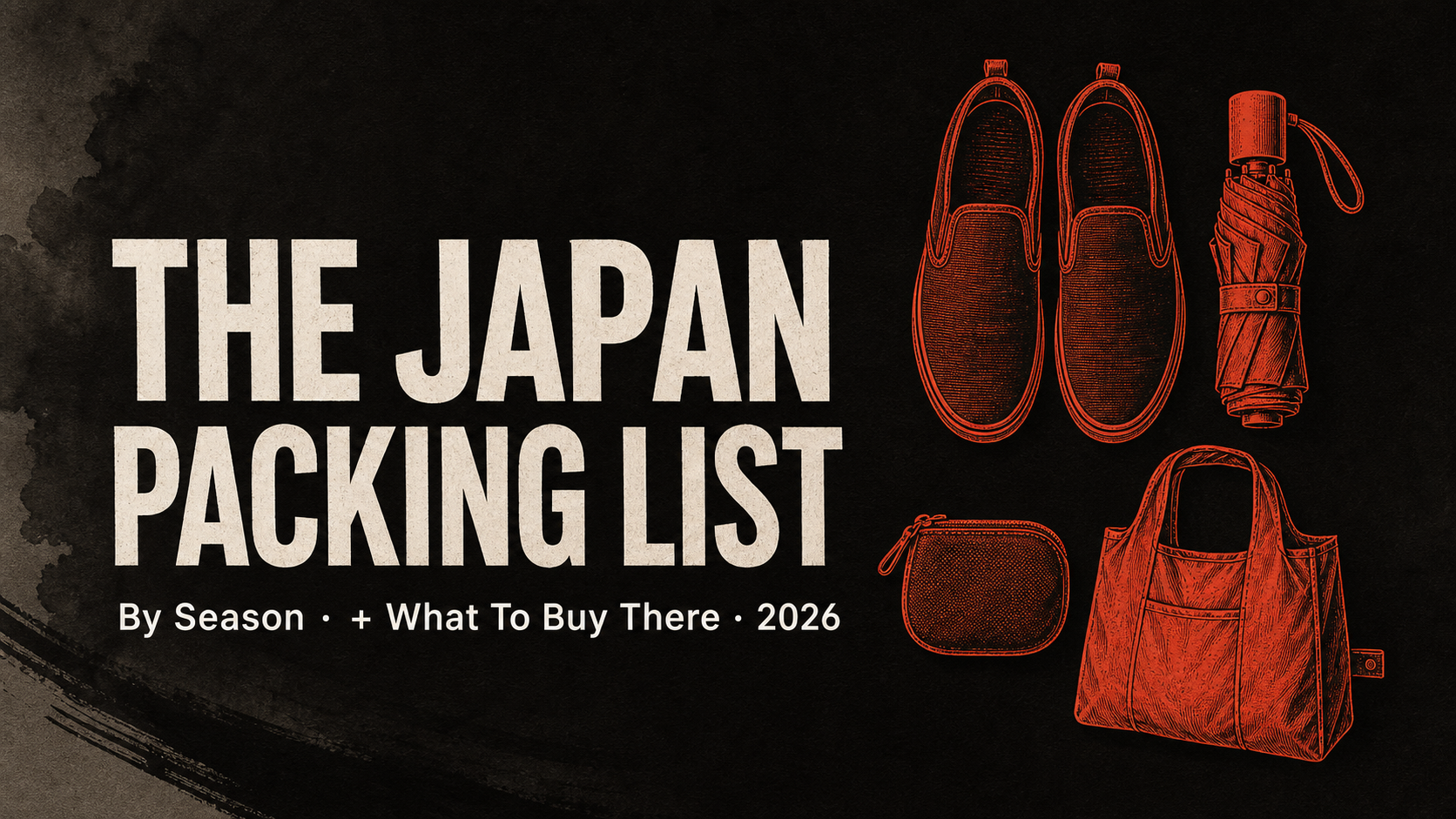
The Japan Packing List by Season (+ What to Buy There Instead) — 2026
Pack for Japan's actual weather, not the average — humid summers, dry sub-zero winters, and the two glorious shoulder seasons — and skip the things you can buy better and cheaper on arrival. Here's a season-by-season checklist, the items that genuinely matter (slip-on shoes, a coin pouch, a foldable bag), and what to deliberately leave home and buy there instead.
Note: Weather varies sharply by region and year, and medication/customs rules change — verify forecasts and current import rules for your specific cities and items before you go. Verified and updated 2026-06.
The Packing Philosophy: Light Bag, Smart Bag
Two ideas drive this whole list:
- Japan punishes over-packing and rewards light travel. You'll haul bags up station stairs, squeeze through turnstiles, and want room for shopping. The country sells nearly everything cheaply, so anything you "might need" you can simply buy on arrival.
- Pack for the interface, not just the weather. The most-forgotten Japan items aren't seasonal — they're about how Japan functions: shoes you take off ten times a day, coins, a bag for trash you'll carry until you find a bin, an umbrella for sudden rain.
What most packing lists get wrong: they give you a generic four-season clothing dump and ignore the half-dozen Japan-specific items that genuinely change your day. We'll do both — but the Japan-specific essentials matter more than the clothes.
📌 Save This: The Season-by-Season Packing Checklist
📌 Save this — find your season, screenshot the column, done. Japan's weather swings hard by region, so always check the forecast for your cities.
| Spring (Mar–May) | Summer (Jun–Aug) | Autumn (Sep–Nov) | Winter (Dec–Feb) | |
|---|---|---|---|---|
| Clothing | Light layers + a light jacket | Breathable, light, quick-dry | Mid layers + a warm jacket | Heavy coat + thermal base layers |
| Rain | Compact umbrella | Umbrella (rainy season + typhoons) | Compact umbrella | — (snow in the north) |
| Footwear | Comfy slip-on walking shoes | Slip-on, breathable | Slip-on walking shoes | Warm, waterproof, slip-on if possible |
| Season extras | Allergy mask (cedar pollen) | Cooling towel, electrolytes, hand fan, sunscreen, hat | (nothing special) | Gloves, hat, scarf, stick-on hand-warmers (kairo) |
| Watch out for | Pollen; sudden cool evenings | Heat + humidity; rainy season; typhoons | Typhoon tail in early autumn | Sub-zero north; bare-but-cold cities; dry air |
Reading the table: the constant in every column is comfortable slip-on walking shoes. The variables are layers and a few season-specific add-ons. Hokkaido and Okinawa can be a full season apart on the same dates — pack for your route, not for "Japan."
Season notes that the table can't fit
- Spring: Glorious, but cedar pollen season is real — hay-fever sufferers should bring or buy a mask and allergy meds. Evenings can still be cool; keep a layer. Cherry blossom timing shifts yearly — see our cherry blossom & autumn leaves guide.
- Summer: Hot and very humid. Expect a rainy season (roughly early summer) and typhoon risk later. Pack breathable, quick-dry clothes and embrace local cooling goods (more below).
- Autumn: Arguably the best travel weather — mild, clear, gorgeous foliage. Early autumn can still catch a typhoon; late autumn cools fast.
- Winter: Tokyo and the Pacific side are chilly but often clear and dry; the north and Sea-of-Japan side get serious snow. Heading to the slopes? See our Niseko & Hokkaido skiing guide for what cold-weather and ski gear to bring vs. rent.
The Japan-Specific Essentials (These Matter Most)
Regardless of season, these are the items that change your day in Japan — the ones generic lists miss:
- Slip-on, broken-in walking shoes. You'll take shoes off constantly (temples, ryokan, some restaurants, homes) and walk far more than you expect. Lace-up boots you struggle with are a daily annoyance; easy slip-ons are bliss.
- A small coin pouch. Japan still runs on cash and coins more than many countries; you'll accumulate heavy ¥500/¥100 coins fast. A coin pouch keeps your wallet sane. (Full cash strategy in our Money in Japan guide.)
- A foldable day bag / tote. For carrying purchases and your own trash — public bins are scarce, so you'll often carry rubbish until you find one. A packable tote also handles inevitable shopping.
- A compact umbrella (or just buy a cheap konbini one on the first rainy day).
- A power bank. Your phone does the maps, translation, IC payments, and train apps all day — keep it charged.
- Prescription medication in original packaging + a doctor's note. Critical: some common foreign medicines (certain cold, allergy, and stimulant medications) are restricted or banned in Japan. Carry a reasonable personal supply, keep documentation, and check current import rules for your specific meds before flying — for larger or controlled quantities you may need an import certificate arranged ahead.
- Plug adapter (most non-North-American travelers). Japan uses Type A plugs at 100V — details in the FAQ.
- Hand sanitizer & a small hand towel. Many public restrooms don't provide paper towels or dryers; a small towel (Japanese-style) is standard.
📌 Save This: What to Buy There Instead
📌 Save this — don't pack these, buy them in Japan:
| 🧳 Pack from home | 🛍️ Buy it in Japan |
|---|---|
| Prescription meds + documentation | Umbrellas (cheap, at every konbini) |
| Comfortable broken-in walking shoes | Socks & cheap clothes (Uniqlo, GU, 100-yen shops) |
| Hard-to-find toiletries / your sizes | Skincare & cosmetics (excellent, great value) |
| Deodorant (limited selection in Japan) | Snacks, toiletries, basics |
| Plug adapter | An extra suitcase for souvenirs |
| A foldable day bag | Heat-tech thermals in winter (Uniqlo) |
| Plus-size / wide-shoe clothing | Cooling goods in summer (cooling towels, sheets, fans) |
Why this works: Japan's everyday retail is superb and cheap. Uniqlo and GU for clothing and HeatTech thermals, 100-yen shops (Daiso, Seria) for everything from umbrellas to packing accessories, drugstores for world-class skincare and toiletries, and convenience stores for umbrellas, socks, and chargers in a pinch. Many visitors literally buy a second suitcase to carry purchases home — see our What to Buy in Japan guide for the best souvenir and shopping targets.
The two things people most regret packing: too many clothes (you'll buy Uniqlo) and bulky toiletries (drugstores have better, smaller). The two things people most regret not packing: their specific medications, and comfortable shoes that fit.
What Locals Actually Carry (and the Seasonal Tricks)
The thing that separates a comfortable Japan trip from a sweaty or shivering one is copying what locals do with cheap, brilliant local goods — most of which you buy there, not pack:
- Summer (the survival kit): Japanese summers are brutal, and the local arsenal is excellent. Pick up a handheld or neck fan, cooling body sheets (menthol wipes that genuinely chill you), a cooling neck towel, and electrolyte drinks (Pocari Sweat, Aquarius). A folding parasol is normal for sun, not just rain — many umbrellas are dual-purpose (hi-gasa). Light, loose, breathable clothing beats anything tight.
- Winter (the warm-without-bulk trick): Don't pack a giant coat — pack layers and buy Uniqlo HeatTech base layers on arrival, which are thin, cheap, and genuinely warm. The local secret weapon is kairo — stick-on or pocket hand-warmer pads sold everywhere in winter; tuck them in pockets, on your lower back, or in your shoes. Cities are dry-cold rather than wet-cold, so wind protection matters more than bulk. The north (Hokkaido, Tohoku) needs real waterproof snow boots.
- Spring (the pollen reality): From roughly late February into spring, cedar and cypress pollen triggers heavy hay fever. If you're sensitive, a mask and antihistamines (bring your own; check import rules) make a real difference. Layers handle the wide day-to-night temperature swings.
- The rainy season (tsuyu) and typhoons: In early summer and again in late summer/early autumn, expect sustained rain and occasional storms. A compact umbrella (or a cheap clear konbini one), quick-dry clothing, and water-resistant shoes keep you moving. Plastic umbrella-bag stands at shop entrances are everywhere — Japan is built around rain.
The pattern: pack the base layers and shoes, then buy the clever seasonal goods locally. Japanese retail has solved its own climate, and it's cheaper and better than anything you'd haul from home.
Packing for Specific Trips
- Skiing/snow (Hokkaido, Tohoku): Bring base layers and gloves; rent skis, boards, boots, and even outerwear locally to save luggage — details in Niseko & Hokkaido skiing.
- Onsen/ryokan stays: You barely need to pack anything — inns provide yukata, towels, toiletries, and slippers. Bring nothing extra for bath nights.
- Traveling with kids: Diapers, formula, wipes, and baby goods are widely available, so pack light and buy the bulky consumables there — full breakdown in Japan with Kids.
- Connectivity: Install a Japan eSIM before you fly so you're online the moment you land — far better than hunting for WiFi with a dead map.
Toiletries & Electronics: The Details That Catch People Out
A few specifics worth getting right before you fly:
- Deodorant: Genuinely worth packing from home. Japanese drugstores carry it, but the selection skews toward mild, sheet-style, or roll-on products and many visitors find the strength or format underwhelming. If you're particular, bring your own.
- Skincare and cosmetics: The opposite — don't pack much. Japanese drugstores (Matsumoto Kiyoshi, Welcia, and others) are a global destination for sunscreen, sheet masks, and skincare at excellent value. Buy there and you'll come home with better products than you brought.
- Sunscreen in summer: You can pack a starter, but Japan's light, non-greasy sunscreens are famously good — restock locally.
- Tampons/period products: Widely available at drugstores and konbini; bring a small supply for the first day, buy the rest there.
- Power and charging: Type A plugs at 100V (see FAQ). Bring a universal adapter if you're not from North America, plus a small multi-port USB charger or power strip so one outlet charges the whole family's devices. A power bank is essential for all-day navigation.
- Hair tools: Check the voltage label — some high-wattage dryers and styling irons underperform or aren't safe at Japan's 100V. Many hotels provide a dryer; for ryokan and onsen stays you rarely need your own.
- A small quick-dry towel: Public restrooms often lack paper towels or dryers; carrying a compact towel (and hand sanitizer) is the local norm.
Pack By Trip Length: Carry-On vs Checked
How much to bring scales with trip length and your laundry plan:
- Short trip (under a week): A carry-on is plenty. Japan's clothing is cheap if you fall short, and many hotels have laundry. Travel light and leave room for shopping.
- Longer trip (1–3 weeks): You still don't need a huge bag — coin laundries (coin randorii) are everywhere and most hotels and many ryokan have machines. Pack roughly a week's worth, do laundry mid-trip, and keep the bag light enough to forward easily.
- The smart move regardless: leave 20–30% of your luggage empty (or bring a foldable extra bag) for the shopping you will do. Many visitors buy a second suitcase outright — it's so common that luggage shops near tourist areas count on it.
The principle: don't pack for the whole trip, pack for a laundry cycle. It keeps your bag mobile through stations and easy to forward between cities.
The Logistics That Make Light Packing Possible
- Forward your luggage (takkyubin). Send big suitcases ahead between hotels (or airport to hotel) and travel city-to-city with a daypack. This is the reason you can pack a smaller bag and still buy plenty.
- Coin lockers at stations hold bags between check-out and check-in.
- Leave 20–30% of your bag empty for shopping, or just plan on the extra suitcase.
Keeping luggage light also keeps you cheap and mobile — see how it ties into spending in our Japan on a budget guide. And while you're prepping, skim the 21 etiquette mistakes so you arrive knowing the shoes-off, trash-carrying, quiet-train norms your packing choices support.
Frequently Asked Questions
What should I pack for Japan that I might forget?
The Japan-specific essentials: slip-on, broken-in walking shoes (you'll remove them constantly and walk far), a coin pouch (still a cash country), a foldable day bag for purchases and trash (bins are scarce), a compact umbrella, and a power bank. Also bring prescription meds in original packaging with documentation, and check current import rules first.
Do I need to pack a lot, or can I buy things in Japan?
Pack light. Cheap quality clothing (Uniqlo, GU, 100-yen shops), umbrellas at every konbini, great skincare, toiletries, snacks, and even an extra suitcase are all easy to buy. Bring only what's hard to find in your size or formulation (some meds, larger Western sizes, specific deodorants) and buy the rest there.
What's the weather like in Japan, and how do I pack for it?
Four distinct seasons with big regional swings. Spring and autumn are mild (light layers); summer is hot and humid with a rainy season and typhoons (breathable clothes, sun protection, umbrella); winter ranges from chilly Tokyo to deep northern snow (warm coat, thermals). Check the forecast for each city on your route.
Can I bring my own medication to Japan?
Sometimes — check first. Japan restricts or bans some common foreign medicines (certain cold, allergy, and stimulant medications). Bring prescriptions in original labeled packaging with documentation, carry only a personal supply, and for larger or controlled quantities you may need an import certificate (Yakkan Shoumei) arranged in advance. Verify your specific meds against current official guidance before traveling.
What kind of power adapter do I need for Japan?
Japan uses Type A plugs (two flat pins, like North America) at 100V. North American travelers usually need no adapter; travelers from Europe, the UK, Australia, and elsewhere need a plug adapter. Most modern electronics handle 100V, but check anything with a heating element or motor (some hair dryers/styling tools). A universal adapter plus a small power strip is handy.
The Takeaway
Pack for Japan's real, region-specific weather; pack the half-dozen Japan-specific essentials that generic lists forget; and deliberately leave room for everything you'll happily buy cheaper there. Light bag in, second suitcase out — that's the Japan packing formula.
Finish prepping:
- What's worth buying there → What to Buy in Japan
- Get connected before you land → Japan eSIM Guide
- Time the seasons right → Cherry Blossoms & Autumn Leaves
- Pack and travel for less → Japan on a Budget
Weather and customs/medication rules vary by region and change over time. Verify current forecasts and import rules for your specific cities and items at official sources before you travel. Verified and updated 2026-06.
Book & compare
This article contains affiliate links. If you book through them we may earn a commission at no extra cost to you. Prices and availability change — always confirm on the official site before booking.
Travel essentials & luggage (Amazon)
Packing cubes, a compact umbrella, a foldable day bag, and a universal plug adapter before you fly. Check current prices and reviews; buy what you can't easily find in Japan.
View on AmazonJapan eSIM (set up before you land)
Install before departure so you're connected the moment you land. Compare current eSIM plans and coverage on the official page before buying.
View on Klook / AiraloLuggage forwarding & day tours
Travel city-to-city with a daypack by forwarding suitcases (takkyubin). Confirm current service details and coverage on the booking page.
View on KlookTravel insurance for Japan
The one thing worth 'packing' that isn't physical. Compare plans and verify coverage before purchasing. Not financial advice.
View on World Nomads