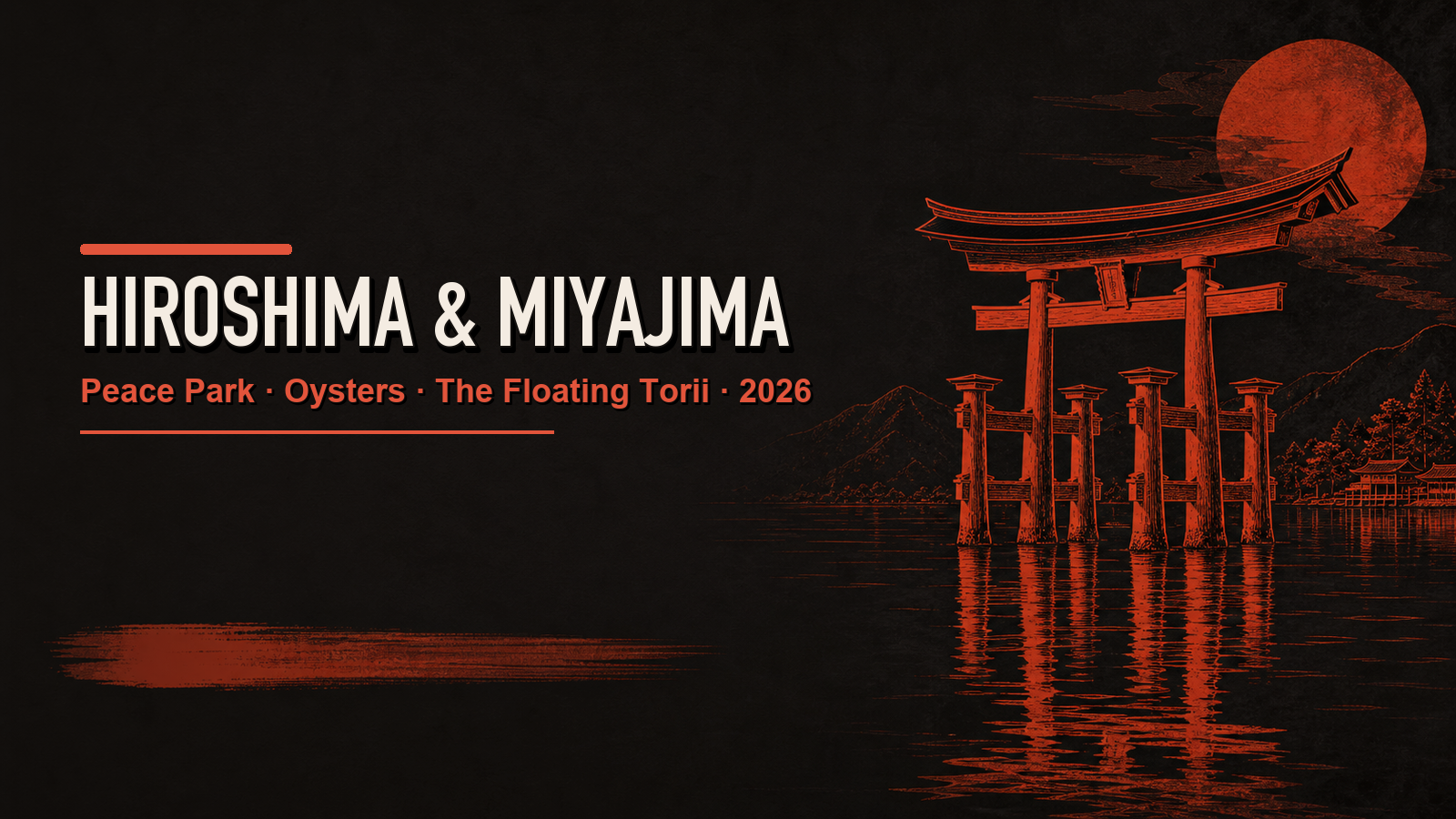
Hiroshima & Miyajima: Peace Park, Oysters & the Floating Torii (2026)
Hiroshima is two trips in one: a city that turned the worst day in human history into the world's most moving argument for peace, and a sacred island where a vermilion gate appears to float on the sea. The catch nobody tells you — the gate only 'floats' at high tide, and Miyajima runs on a tide table. This guide gives you the 1–2 day plan, the exact tide-and-ferry strategy, and how to walk the Peace Park so it lands.
Note: Tide times, ferry and tram schedules, museum hours, and prices change frequently and the torii/shrine undergo periodic maintenance. Times here are illustrative for planning — verify current details, especially the tide table and any construction, at the official sources linked throughout. Verified and updated 2026-06.
What Most Guides Get Wrong About Hiroshima & Miyajima
Most guides give you a flat list — "see the Peace Park, see the floating torii" — and miss the two things that actually make or break the visit:
- The torii runs on the tide, not the clock. Travelers show up at Miyajima, find the famous gate sitting on dry sand, and feel cheated. It's not broken — it's low tide. The single most important planning step for Miyajima is checking the tide table and deciding whether you want the floating-reflection shot (high tide) or the walk-out-and-touch-it experience (low tide). Ideally you time your hours to catch both.
- The Peace Park has an emotional arc, and order matters. Walked in the right sequence — the Dome, the monuments, the Cenotaph, then the Museum last — it builds to a gut-punch and a quiet catharsis. Done backwards (museum first, on an empty emotional stomach), it can overwhelm before it contextualizes. Walk it in order, and leave the Museum for the end.
Two more facts shape the trip:
- Getting between them is easy but multi-leg. Hiroshima city to the Miyajima ferry is a train (JR Sanyo Line or the slower, scenic Hiroden tram) to Miyajimaguchi, then a 10-minute ferry to the island. Budget the legs.
- One day works; two days is the upgrade. You can do both in a day. But the island after dark — quiet, deer-strewn, the torii illuminated — is a different, better thing.
📌 Save this — the Miyajima tide-and-ferry cheat-sheet:
- Step 1: Check the tide table. Search "Miyajima tide table" for your date. Note the high-tide and low-tide times.
- High tide = the floating torii reflection shot (the classic photo). Best near dawn or dusk for light and calm water.
- Low tide = you can walk across the flats to the gate, touch its pillars, and spot the coins wedged in the cracks.
- Ideal: arrive to catch one, linger or return for the other — the tide swings over a few hours.
- Ferry: train/tram to Miyajimaguchi → ~10-min ferry to the island. Two operators run it (JR and a private line); the JR ferry is covered by a Japan Rail Pass and one route swings closer to the gate at high tide.
- Heads-up: the torii and Itsukushima Shrine undergo periodic maintenance/scaffolding — check current status before you go so it's not a surprise.
The Perfect Hiroshima + Miyajima Plan, 1 Day and 2 Days
This is the realistic, train-and-ferry-connected sequence. Base near Hiroshima Station for transit, or on Miyajima itself for the after-dark torii — see "Where to base yourself" below.
📌 Save this — the 1-day plan (fast but doable):
Time Where What 8:30 Peace Memorial Park Walk it in order: A-Bomb Dome → monuments → Cenotaph 9:30 Peace Memorial Museum Allow 90+ min; emotionally heavy — do it before the island 12:00 Hiroshima city lunch Layered Hiroshima-style okonomiyaki off a teppan 13:30 Train/tram → Miyajimaguchi → ferry ~45–60 min door to island 14:30 Miyajima Itsukushima Shrine, the torii (timed to the tide), grilled oysters, the deer 17:30 Torii at golden hour If the tide cooperates, the floating gate at dusk 19:00 Ferry back / dinner in Hiroshima
📌 Save this — the 2-day plan (the upgrade):
Day 1 — Hiroshima city: Peace Memorial Park (slowly), the Museum, lunch okonomiyaki, then Shukkei-en garden or the castle in the afternoon; dinner of oysters in the city. Day 2 — Miyajima, overnight on the island: ferry over mid-morning, Itsukushima Shrine, the Daisho-in temple up the slope, the Mt. Misen ropeway-and-hike for the island's best view, oysters and momiji manju on the main street. Stay the night so you see the illuminated torii after the day-ferries leave, the island silent and the deer wandering. Catch the opposite tide in the morning before you go.
Why the order works: doing the Peace Park and Museum first, on a clear morning, gives that experience the focus it deserves before the day gets logistical. The island in the afternoon and evening lets you ride the tide toward the golden-hour torii. The two-day version's real prize is sleeping on Miyajima — the single thing that separates a memorable visit from a transcendent one.
Pair the food stops with our Japan food guide for how Hiroshima-style okonomiyaki differs from Osaka's, and how to order at a busy teppan counter.
Walking the Peace Memorial Park (In Order)
The park sits on the delta where the bomb detonated on August 6, 1945. Walk it slowly and in sequence — the layout is designed as a journey from destruction to remembrance to hope:
- A-Bomb Dome (Genbaku Dome). The preserved skeletal ruin of the old Industrial Promotion Hall, left exactly as the blast left it. A UNESCO World Heritage Site and the visual heart of Hiroshima's memory. Start here.
- Aioi Bridge. The distinctive T-shaped bridge was the bomb's aiming point — its shape made it easy to spot from the air. Cross or pause at it to grasp the geography of that morning.
- Children's Peace Monument. Topped by a statue of Sadako Sasaki, the girl who folded paper cranes while dying of radiation-induced leukemia. The surrounding cases overflow with thousands of folded cranes sent by children worldwide. This is the park's most quietly devastating stop.
- The Cenotaph & the Flame of Peace. An arched stone tomb holding the names of all known victims, framing a view straight through to the A-Bomb Dome, with an eternal flame that will burn until the world's last nuclear weapon is gone.
- The Pond and the framed view back to the Dome through the Cenotaph's arch — the park's defining photograph and its emotional centerline.
- Peace Memorial Museum. Go last, and allow at least 90 minutes. The exhibits — personal belongings, testimonies, scientific reckoning of the blast — are graphic and profoundly moving. Doing it after the outdoor park means you arrive already in the right frame of mind, not blindsided.
What most guides get wrong here: they list the museum first because it's the "main attraction." Reverse it. Walk the outdoor park first to feel the place and its geography, then let the museum deepen and contextualize it. And go in the morning when you have the emotional energy — this is not an end-of-a-tiring-day activity.
What to Eat: Oysters, Layered Okonomiyaki & Momiji Manju
Hiroshima's table has three signatures you should not miss:
- Oysters (kaki). Hiroshima produces the lion's share of Japan's oysters, and they're spectacular — grilled in the shell, deep-fried (kaki fry), or raw, best in the cooler months (roughly autumn through early spring). On Miyajima's main street, grilled oysters are the street snack.
- Hiroshima-style okonomiyaki. Crucially different from Osaka's: instead of mixing everything into the batter, Hiroshima layers it — a thin crepe, a tall heap of cabbage, pork, and a nest of yakisoba noodles, all griddled and pressed together and finished with sauce and egg. Eat it hot off a teppan counter; the multi-floor okonomiyaki buildings (stacked with tiny competing stalls) are a Hiroshima institution.
- Momiji manju. Miyajima's iconic souvenir snack — maple-leaf-shaped cakes filled with red-bean paste, custard, chocolate, or cheese. Buy them fresh and warm on the island's main street, where you can watch them griddled.
Pair the food planning with our broader Japan food guide, and if you're plant-based, note that Hiroshima okonomiyaki and dashi-based dishes need careful ordering — see our halal, vegetarian & vegan guide.
Getting There & Around
- To Hiroshima: the Sanyo Shinkansen puts the city ~1.5 hours from Osaka and under 2 hours from Kyoto, making it a long day-trip or, better, an overnight from the Kansai region — or a stop on a westbound route toward Kyushu. Whether a Japan Rail Pass pays off depends on your whole itinerary; one Osaka–Hiroshima round trip alone rarely justifies the nationwide pass, but a longer multi-city trip can tip it.
- To Miyajima: from Hiroshima, take the JR Sanyo Line (
25 min) or the slower, scenic Hiroden tram (70 min, but a fun ride through the city) to Miyajimaguchi, then the ~10-minute ferry to the island. Two ferry operators run the crossing; the JR ferry is covered by a Japan Rail Pass and on one route loops closer to the great torii at high tide. - On the islands and in the city: Hiroshima's Hiroden tram network is the easy way around the city center, including to the Peace Park (Genbaku Dome-mae stop). Miyajima itself is walkable, with the Mt. Misen ropeway for the summit.
For where this fits in a longer trip, see our 5-day Japan itinerary, which can extend westward to Hiroshima.
The Hiroshima & Miyajima Pitfalls Most Visitors Walk Into
- Not checking the tide. The number-one mistake. Show up at the wrong tide and the "floating" torii is parked on sand. Check the Miyajima tide table first and plan your hours — ideally catch both states.
- Doing the Museum before the park. It hits harder and lands worse out of sequence. Outdoor park first, Museum last.
- Rushing Miyajima as a 90-minute photo stop. The island has the shrine, the Daisho-in temple, Mt. Misen's summit views, oysters, deer, and the after-dark magic. Give it half a day minimum; a night if you can.
- Forgetting the deer are wild. Miyajima's deer, like Nara's, will nose into bags and snatch food and paper (including maps and tickets). Keep food and documents zipped away. Don't feed them.
- Assuming the torii is always there to photograph. Itsukushima Shrine and the gate undergo periodic restoration with scaffolding. Check current status before you build the trip around the photo.
- Treating Hiroshima as only the bomb. It's also a lively, green, modern city with gardens (Shukkei-en), a castle, and a great food scene. Don't leave the moment you finish the Peace Park.
How Many Days?
- 1 day (day-trip from Osaka/Kyoto): Peace Park and Museum in the morning, okonomiyaki lunch, Miyajima in the afternoon — fast but real. Best if you're tight on time.
- 2 days (the upgrade): A full, unhurried Hiroshima day, then overnight on Miyajima for the illuminated torii and the empty-island evening. This is the version people remember.
- Add-on: Hiroshima pairs naturally with a westbound route — continue toward Kyushu (our Kyushu onsen circuit is a natural next leg) or loop back to Kansai.
📌 Save this — the Hiroshima & Miyajima rules:
- Check the Miyajima tide table first — high tide floats the gate, low tide lets you walk to it.
- Walk the Peace Park in order; do the Museum last and in the morning.
- Overnight on Miyajima if you can — the after-dark island is the best part.
- Eat the oysters and the layered okonomiyaki; grab momiji manju on the island.
- Keep food and tickets zipped away from the deer.
Where to Base Yourself
- Hiroshima city (near the Station or Peace Park): the convenient base — best transport links, the widest range of hotels and restaurants, and a single hub for the Peace Park plus westbound trips. Most travelers stay here.
- Miyajima island: the magical base. The island's ryokan put you steps from the shrine, and after the last day-ferry leaves, you get the illuminated torii and the quiet, deer-strewn island nearly to yourself. Pricier, with fewer dinner options, but unforgettable. Book well ahead — island rooms are limited.
Compare current options on the booking links above. For where Hiroshima sits in a bigger trip, see our first-timer's hub and 5-day itinerary.
When to Go
- Autumn (October–November): arguably the best — oyster season ramps up, the foliage at Mt. Misen and Daisho-in is superb, and the weather is clear. Track the timing in our autumn leaves guide.
- Winter (December–February): peak oyster season and the quietest, with the torii starkly beautiful over cold water.
- Spring (late March–April): cherry blossoms around the Peace Park and on Miyajima; lovely but busy.
- Summer (June–August): humid, but the period around August 6 holds the deeply moving Peace Memorial Ceremony and the evening lantern-floating on the rivers — a profound, if crowded, time to visit.
Frequently Asked Questions
Can I do Hiroshima and Miyajima in one day?
Yes, if you start early: Peace Park and Museum in the morning (2.5–3 hours), city lunch, then train-and-ferry to Miyajima for the afternoon and the torii. The constraint is the tide — check the Miyajima tide table before building the day. Two days, with an overnight on the island, is the better version.
Why does the floating torii sometimes sit on dry sand?
Because the gate stands on a tidal flat. At high tide the sea surrounds it and it appears to float (the classic shot); at low tide the water recedes and you can walk to its pillars. Neither is wrong — catch both if you can. Always check the tide table first.
Is the Peace Memorial Museum too intense for kids?
It's emotionally heavy and parts are graphic, so use judgment with younger children. The outdoor park — the Dome, the paper-crane monument, the Cenotaph — is moving but appropriate for most ages. Many families do the park and decide on the indoor museum based on the kids. See our Japan with kids guide.
What should I eat in Hiroshima?
Oysters (Hiroshima is Japan's oyster capital) and Hiroshima-style okonomiyaki — layered, not mixed like Osaka's, with a nest of yakisoba noodles, off a teppan. On Miyajima, grilled oysters and momiji manju (maple-leaf cakes). More in our food guide.
How do I get to Hiroshima, and is the rail pass worth it?
The Sanyo Shinkansen — ~1.5 hours from Osaka, under 2 from Kyoto. A single round trip rarely justifies the nationwide Japan Rail Pass, but a longer multi-city trip can tip the math. Run your own numbers.
Should I sleep in Hiroshima city or on Miyajima island?
City for transport, restaurants, and convenience. Miyajima for the magic — the illuminated torii and the quiet island after the day-ferries leave. Pricier with fewer dinner options, but the after-dark island is the experience most visitors miss.
Summary: Hiroshima & Miyajima, the Right Way
- Morning: walk the Peace Memorial Park in order — Dome, monuments, Cenotaph — and do the Museum last.
- Lunch: layered Hiroshima okonomiyaki off a teppan.
- Afternoon: train-and-ferry to Miyajima, timed to the tide table.
- Golden hour: the floating torii at dusk (high tide) or walking out to its pillars (low tide).
- The upgrade: overnight on the island for the illuminated gate and the empty, deer-quiet evening.
Hiroshima asks something of you — to stand in a place of unspeakable history and leave hopeful — and Miyajima gives back beauty that runs on the tide. Plan around the tide, walk the park in order, and stay the night if you can. String it into a bigger trip with our 5-day itinerary, pair it with the temples in our Kyoto perfect day, and if this is your first trip, start at the first-timer's hub.
All tide times, ferry and tram schedules, museum hours, prices, and torii/shrine maintenance status in this article are for planning orientation only and change frequently. Verify current details at the official sources linked throughout. Information verified and updated 2026-06.
Book & compare
This article contains affiliate links. If you book through them we may earn a commission at no extra cost to you. Prices and availability change — always confirm on the official site before booking.
Hiroshima & Miyajima tours and day-trips
Guided Peace Park walks, Miyajima ferry-and-island combos, and day-trips from Osaka or Kyoto. Compare current options and pricing before booking.
View on KlookGetYourGuide Hiroshima experiences
Good for English-guided Peace Park tours and Miyajima excursions. Check current availability and pricing.
View on GetYourGuideHiroshima & Miyajima hotels — Booking.com
Stay near Hiroshima Station for transit, or on Miyajima itself for the after-dark torii. Prices vary by season — check current rates.
View on Booking.comMiyajima ryokan on Rakuten Travel
An overnight on Miyajima lets you see the floating torii lit up after the day-trippers leave. Confirm current availability and meal plans.
View on Rakuten TravelAiralo Japan eSIM
You'll want live tide tables, ferry times, and maps all day. Have data on arrival — check current plans on the official site.
View on Airalo