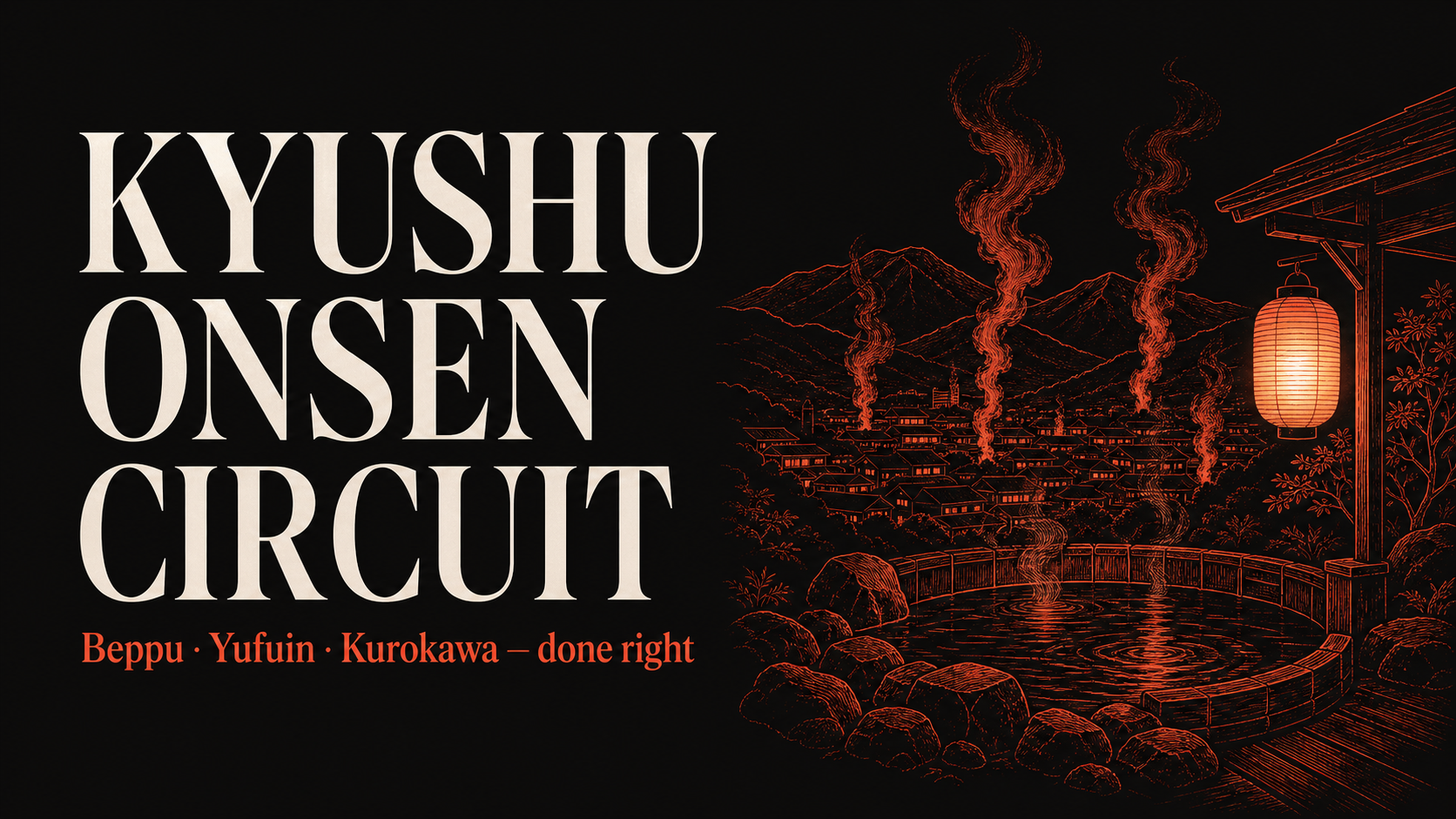
Kyushu Onsen Circuit: Beppu, Yufuin & Kurokawa Done Right (2026)
Beppu's steaming hells, Yufuin's elegant mornings and Kurokawa's lantern-lit baths are the holy trinity of Kyushu hot springs. Here's how to loop all three the smart way — with the right ryokan, the right order, and the right rail pass.
Note: Onsen, ryokan, hells-tour and transport details change seasonally; pricing, bath access and tattoo policies vary by property. Everything below is general guidance — confirm current details on official town, ryokan and JR Kyushu sites linked throughout. Verified · updated 2026-06.
The 60-second version
- Where: Central Kyushu, mostly in Oita and Kumamoto prefectures, gatewayed from Fukuoka (Hakata).
- Beppu — Japan's onsen capital by volume; the "hells" (jigoku) tour of vividly coloured volcanic springs you look at, plus countless baths you soak in.
- Yufuin — an elegant hot-spring village under Mount Yufu; galleries, cafés, a postcard pond (Kinrinko), and standout ryokan. Best enjoyed early morning before the day-trippers arrive.
- Kurokawa — a tiny, deliberately rustic onsen hamlet famous for its wooden bath-hopping pass (nyuto tegata) and lantern-lit rotenburo. No train — bus or car only.
- The plan: Loop all three over 3–4 days. Trains do Beppu and Yufuin; a highway bus does Kurokawa.
If you're chaining this with western Honshu, it pairs naturally with our Setouchi art islands + Shimanami Kaido route, and with the wider 5-day Japan itinerary as a regional add-on.
Beppu vs Yufuin vs Kurokawa: which town for which traveler
You don't have to choose — but knowing each town's character lets you spend your nights well.
| Beppu | Yufuin | Kurokawa | |
|---|---|---|---|
| Character | Bustling steam-city | Chic resort village | Secluded valley hamlet |
| Signature experience | The "hells" sightseeing tour | Morning strolls, galleries, Kinrinko pond | Onsen-hopping pass, lantern-lit baths |
| Crowd level | High, spread out | High by day, quiet at dawn | Moderate, intimate |
| Access | Train + bus (easy) | Direct limited express from Fukuoka | Bus or car only — no train |
| Best ryokan style | Variety, all budgets | Refined, design-led | Rustic wooden, river-side |
| Ideal nights | 1 | 1 | 1–2 |
| Best for | Variety, families, first-timers | Couples, your splurge ryokan | Rustic romance, bath collectors |
Getting there and looping the circuit
Gateway: Fukuoka (Hakata)
Most travellers enter via Fukuoka, reached by Shinkansen from Honshu or by air. From Hakata Station, JR limited express trains run toward Beppu and Yufuin.
The connections (and the one that isn't a train)
- Fukuoka (Hakata) → Beppu: JR limited express Sonic along the coast. Straightforward.
- Beppu → Yufuin: Short hop inland; the scenic Yufuin no Mori limited express is a destination in itself (reserve ahead — it's popular). Buses also connect the two.
- Yufuin → Kurokawa: No train. A direct highway bus links Yufuin to Kurokawa (and buses also run from Fukuoka and via Aso/Kumamoto). This is the leg people forget to plan.
- Out of Kurokawa: Bus onward to Kumamoto (and Mount Aso scenery en route) or back toward Fukuoka.
📌 Save this — Kyushu onsen loop routing rule:
- Fukuoka → Beppu by JR limited express Sonic (overnight Beppu).
- Beppu → Yufuin by Yufuin no Mori limited express (reserve seats) or local bus (overnight Yufuin).
- Yufuin → Kurokawa by highway bus — there is NO train to Kurokawa. Book the bus; check the timetable first (overnight Kurokawa).
- Kurokawa → out by bus to Kumamoto (do Mount Aso en route) or back to Fukuoka.
- Pass logic: A JR Kyushu pass covers the train legs (Beppu, Yufuin). It does not cover the Kurokawa bus — don't assume one ticket does everything.
Does the JR Kyushu Pass pay off?
A JR Kyushu Rail Pass can be worth it if you're doing several limited-express legs (Fukuoka–Beppu–Yufuin and onward to Kumamoto/Kagoshima), but remember it covers trains only — the Kurokawa bus is separate. Do the same break-even math we walk through in our Is the JR Pass worth it in 2026? guide, but against JR Kyushu's regional pass and your specific legs. Verify current pass types and prices on the official JR Kyushu site before buying.
Beppu: do the hells and a real bath
Beppu produces more hot-spring water than anywhere else in Japan, and it shows — steam rises from drains and hillsides all over town. There are two distinct things to do here, and tourists often do only the first.
The "hells" (jigoku) — smart way to tour them
The jigoku meguri ("hells tour") is a circuit of vividly coloured volcanic springs that are for looking, not bathing — a cobalt-blue pond, a blood-red one, a geyser. There are several official hells, split across two clusters (a main Kannawa group and a couple further out at Shibaseki).
The smart way to do it:
- Buy the combination ticket that covers multiple hells rather than paying per pond — verify the current common-ticket details on the Beppu hells official site.
- Cluster, don't crisscross: do the walkable Kannawa-area hells together on foot, then take a short bus to the two outlying ones — don't ping-pong back and forth.
- Go early. Tour buses arrive mid-morning; the first hour after opening is calmest.
- Manage expectations: the hells are colourful and geologically fun, but they're a sightseeing loop. Budget a half-day, not a full one.
Then actually bathe
The hells are the postcard; the baths are the point. Beppu has multiple bath districts (the steamy Kannawa area is famous for steam baths and sand baths — sunayu, where you're buried in naturally heated sand). Choose a ryokan or day-bath in the district that suits you, and don't leave town having only photographed water without soaking in it.
Overnight in Beppu to enjoy a bath in the evening and morning. Beppu's huge range means options for every budget — compare on Rakuten Travel or Booking.com.
Yufuin: the slow morning
Yufuin is the refined counterpoint to Beppu's steamy bustle — a village of galleries, craft shops and design-forward ryokan strung beneath the twin peaks of Mount Yufu.
Why the morning is the whole strategy
Yufuin floods with day-trippers from late morning. The move is to stay overnight and own the early hours: walk the main lane and the path to Kinrinko pond at dawn, when mist often hangs over the water and the shops haven't opened. By the time the crowds arrive, you can retreat to your ryokan's bath.
What to do
- Kinrinko pond at sunrise — quiet, atmospheric, frequently misty.
- The main street galleries, craft shops and cafés (sweets and local produce) — pleasant once you've had your quiet morning.
- A refined ryokan stay — Yufuin is where many travellers spend on their nicest inn of the trip, often with a private open-air bath and elaborate kaiseki dinner.
The Yufuin no Mori train
Arriving (or leaving) on the Yufuin no Mori — a handsome green sightseeing limited express — is part of the experience. Reserve seats well ahead; it's popular and sells out.
Overnight in Yufuin for the morning payoff. This is the night to splurge on a room with its own rotenburo.
Kurokawa: bath-hopping by lantern light
Kurokawa is the connoisseur's choice — a small, intentionally low-key hamlet in a wooded valley in Kumamoto Prefecture, with no neon, no train station, and a strict aesthetic of dark wood and warm lanterns. Its whole identity is built around one brilliant idea.
The onsen-hopping pass (nyuto tegata)
📌 Save this — Kurokawa nyuto tegata bath-hopping how-to:
- What it is: a round wooden token (tegata) sold in the village that admits you to the open-air baths (rotenburo) of three participating ryokan of your choosing — without staying at them.
- How to use it: buy it at the village information centre or a participating inn; walk between ryokan on foot; hang the wooden token outside the bath while you soak; move on to your next choice.
- Why it's the point: Kurokawa's magic is sampling several distinct riverside and forest baths in one evening or morning, lantern-lit, rather than only using your own inn's bath.
- Best paired with: an overnight stay so you can bathe at dawn and dusk when the village is most atmospheric.
- Verify: the current price, number of baths and participating ryokan on the official Kurokawa Onsen site — these change.
Getting there and staying
Kurokawa is bus or car only. Take the highway bus from Yufuin, Fukuoka, or via Aso/Kumamoto, then settle into a wooden ryokan along the Tanohara River. Many inns have riverside or forest rotenburo. This is a place to slow all the way down: dinner in your room or a quiet hall, a bath under the stars, the bath-hopping token in the morning.
Overnight (ideally one to two nights) in Kurokawa. Compare ryokan on Rakuten Travel, and confirm each inn's private-bath and tattoo policies directly.
Onsen etiquette in 90 seconds
Onsen are simple once you know the rhythm. Do this and you'll fit right in:
📌 Save this — onsen etiquette checklist:
- Bathe naked. No swimwear in traditional onsen baths.
- Wash before you soak. Sit at the shower stations, rinse thoroughly, then enter the communal bath clean.
- Small towel: out of the water. Rest it on your head or the side — don't dip it in the bath.
- Tie up long hair so it doesn't touch the water.
- No phones, no photos in bathing areas.
- Tattoos: many baths restrict visible tattoos. Use a private in-room bath (kashitsuki rotenburo), reserve a private bath (kashikiri), cover small tattoos, or pick a tattoo-friendly inn — confirm policy when booking.
- Hydrate and don't overdo it — these are hot, mineral-rich waters; step out if you feel light-headed.
Choosing the right ryokan: private vs in-room open-air baths
The biggest comfort decision is what kind of bath you want access to. Three tiers:
- Shared indoor/outdoor baths only (most economical): You use the inn's communal baths. Great value; less privacy; tattoo restrictions may apply.
- Kashikiri (reservable private bath): The inn has a private bath you book for a 45–60 minute slot. Solves privacy and tattoo concerns for a session.
- Room with private open-air bath (kashitsuki rotenburo — the splurge): Your own room has an attached open-air bath you can use anytime. The ultimate Yufuin/Kurokawa indulgence and the cleanest solution for couples and tattooed travellers.
📌 Save this — ryokan bath decision rule:
- Want max value / don't mind sharing → standard ryokan, communal baths (check tattoo policy).
- Want privacy now and then / have small tattoos → ryokan with a kashikiri private bath you can reserve.
- Want a soak anytime + total privacy (couples, larger tattoos) → book a room with its own rotenburo — spend here in Yufuin or Kurokawa, save in Beppu.
When booking on Rakuten Travel or Booking.com, filter for "private open-air bath" / "room with onsen" and confirm the bath type and tattoo policy on the property page — listings vary in how clearly they state this.
When to go
- Autumn (roughly Oct–Nov): arguably the best — crisp air makes hot baths sublime, and the valleys around Kurokawa and Aso turn colour. Book ryokan early.
- Winter: wonderful for onsen — steam and cold air are the classic combination — but check transport in snow, especially mountain bus routes.
- Spring: mild and green; cherry blossoms in places.
- Summer (esp. the June rainy season and midsummer heat): the least magical time for hot baths, though valleys stay cooler than the cities.
Mornings everywhere beat the crowds — this is a recurring theme: stay overnight, bathe at dawn.
What most guides get wrong
- They treat Kurokawa like a train town. It isn't — there's no station. People build rail itineraries that strand them. Plan the bus explicitly.
- They stop at the Beppu hells. The hells are a half-day photo loop; the actual onsen baths are the reason to be in Beppu. Do both.
- They visit Yufuin midday. That's exactly when it's most crowded. The whole value is the early morning — which means staying the night.
- They assume one pass covers everything. A JR Kyushu pass covers trains, not the Kurokawa bus or local sightseeing buses. Budget those separately.
- They ignore tattoos until check-in. Sort your bath strategy (private/kashikiri/tattoo-friendly) at booking time, not at the bath entrance.
A clean 3–4 day plan
- Day 1 — Beppu: in from Fukuoka by Sonic. Hells tour (combination ticket, go early), then a real bath in the Kannawa district; overnight Beppu.
- Day 2 — Yufuin: ride the Yufuin no Mori (or bus). Galleries and Kinrinko in the afternoon; refined ryokan with a private bath; overnight Yufuin.
- Day 3 — Kurokawa: highway bus over to Kurokawa. Buy the nyuto tegata, hop three baths by lantern light; overnight Kurokawa.
- Day 4 — out: bus toward Kumamoto, taking in Mount Aso scenery en route, or back to Fukuoka — then onward.
Pair it before or after with Setouchi's art islands and Shimanami Kaido, the old-Japan towns in our Kyoto alternatives guide, or the elegant Kanazawa & Hokuriku coast for a full slow-Japan trip. For booking the wider transport picture, see Best Japan experiences to book ahead.
Frequently Asked Questions
Can I visit Beppu, Yufuin and Kurokawa without a car? Beppu and Yufuin yes, Kurokawa partly. Beppu and Yufuin are both on the JR limited express network from Fukuoka (Hakata) and connect to each other by train and bus. Kurokawa Onsen, however, has no train station — you reach it by highway bus (from Fukuoka, Kumamoto or via Aso) or by car. Many no-car travellers do Beppu and Yufuin by rail, then take a direct highway bus to Kurokawa. Confirm current bus routes and timetables on the operator and town tourism sites for your dates.
What is the Kurokawa onsen-hopping pass and how does it work? Kurokawa Onsen sells a wooden 'nyuto tegata' bath-hopping pass that lets you enter the open-air baths (rotenburo) of three participating ryokan of your choice from the many in the village. You hang the wooden token outside while you bathe and move between inns on foot. It's the signature Kurokawa experience and ideal if you're staying overnight and want to sample several baths rather than just your own ryokan's. Buy it at the village information centre or participating inns; verify the current price, number of baths and participating ryokan on the official Kurokawa Onsen site, as details change.
I have tattoos — can I still use onsen in Kyushu? Often yes, with the right choice. Many traditional public baths still prohibit visible tattoos, but you have good workarounds: book a ryokan room with a private in-room open-air bath (kashitsuki rotenburo), reserve a private bath slot (kashikiri onsen), or choose one of the increasingly common tattoo-friendly facilities. Kurokawa's bath-hopping and Beppu's variety make it easy to find private options. Always confirm the specific property's tattoo policy when booking rather than assuming.
How many days do I need for the Kyushu onsen circuit? Three to four days is the sweet spot: one night in Beppu (hells tour plus a soak), one night in Yufuin (slow morning, galleries, a refined ryokan), and one night in Kurokawa (bath-hopping by lantern light). Add a day if you want to fold in Mount Aso's scenery or start/end in Kumamoto. You can compress to a fast two-night Beppu+Yufuin loop from Fukuoka, but Kurokawa is worth the extra night.
Summary
Kyushu's onsen trinity is about sequence and ryokan choice, not picking favourites:
- Beppu for variety — do the hells (combination ticket, early) and a proper bath; overnight.
- Yufuin for elegance — stay the night and own the misty early morning at Kinrinko before the crowds.
- Kurokawa for soul — buy the nyuto tegata and hop three lantern-lit baths; remember it's bus-only.
- Choose your bath strategy at booking — a room with its own rotenburo or a reservable private bath solves privacy and tattoo questions.
- Mind the pass math — JR Kyushu covers trains, not the Kurokawa bus.
- Give it 3–4 days, ideally in autumn or winter, and bathe at dawn and dusk.
Plan the bus, reserve the ryokan, learn the etiquette once — and Kyushu will give you the most restorative leg of your Japan trip.
Onsen access, hells-tour tickets, ryokan availability, bus and train timetables, pass pricing and tattoo policies all change. Everything here is general guidance only. Verify every time-sensitive detail — bath rules, schedules, reservations and prices — on official town, ryokan and JR Kyushu sites before booking. Verified · updated 2026-06.
Book & compare
This article contains affiliate links. If you book through them we may earn a commission at no extra cost to you. Prices and availability change — always confirm on the official site before booking.
Kyushu Ryokan & Onsen Hotels
Strong inventory of Japanese ryokan including private-bath and room-with-rotenburo options in Beppu, Yufuin and Kurokawa. Verify current rates, meal plans and bath details on each property page.
View on Rakuten TravelBeppu, Yufuin & Kurokawa Ryokan
Compare onsen ryokan and hotels across Oita and Kumamoto. Filter for private/open-air baths; confirm tattoo and reservation policies with the property.
View on Booking.comJR Kyushu Rail Pass (Official)
Official JR Kyushu pass covering limited express trains across the island. Verify current pass types, coverage and pricing before buying — note Kurokawa is reached by bus, not train.
View on JR KyushuBeppu & Yufuin Tours, Transfers & Activities
Hells-tour passes, transfers and experiences around Beppu and Yufuin. Confirm current inclusions and timings on the booking page.
View on Klook